铸铁链轮 欧洲标准 | GG22-GG25 DIN 8187 大直径
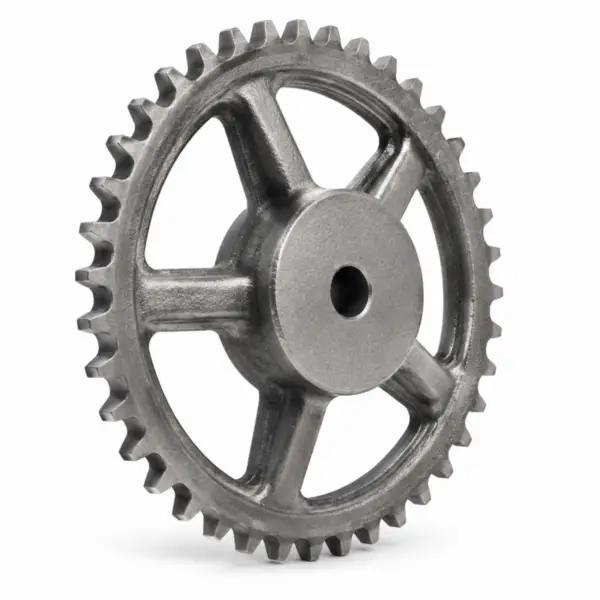
Grey cast iron sprockets GG22–GG25 to DIN 8187 / ISO R606. Large-diameter, high tooth count range: Z=30 to Z=150. Chain sizes 06B through 24B, simplex to triplex. Surface phosphated. For slow, heavy industrial, quarry, mining and agricultural drives. Korea Ever-Power factory-direct.
06B – 24B
Chain Size Range
Z=30 – 150
Tooth Count Range
GG22 – GG25
Grey Cast Iron Grade
ISO 9001
认证质量
Cast Iron Sprockets – Product Overview
Korea Ever-Power cast iron sprockets cover the large-diameter, high tooth count end of the European standard sprocket range — chain sizes 06B through 24B, tooth counts Z=30 to Z=150, in simplex, duplex and triplex configurations to DIN 8187 / ISO R606. These are the correct choice for slow-speed, heavy-load industrial drives where large pitch circle diameters are required and where the operating environment makes carbon steel sprockets unsuitable or uneconomical.
The material is grey cast iron to grade GG22–GG25 (EN-GJL-220 to EN-GJL-250). Grey cast iron has a lamellar graphite microstructure that gives it properties quite different from carbon steel: the graphite lamellae act as an internal solid lubricant at the tooth contact surface, providing inherent wear resistance without external hardening. This is particularly valuable in dusty, abrasive or poorly lubricated environments where a ground-smooth carbon steel tooth flank would be rapidly abraded, but the cast iron surface — slightly porous and graphite-rich — retains a lubrication film and resists micro-abrasion far better.
All cast iron sprockets are surface phosphated after casting and machining. Phosphating converts the outer surface layer to iron phosphate — a tightly adherent, oil-retaining conversion coating that provides a degree of corrosion protection and lubricant retention on the tooth flanks and bore surfaces. It does not add dimensional build-up (typically 1–5 µm thickness) and does not require any correction to bore tolerances after treatment.
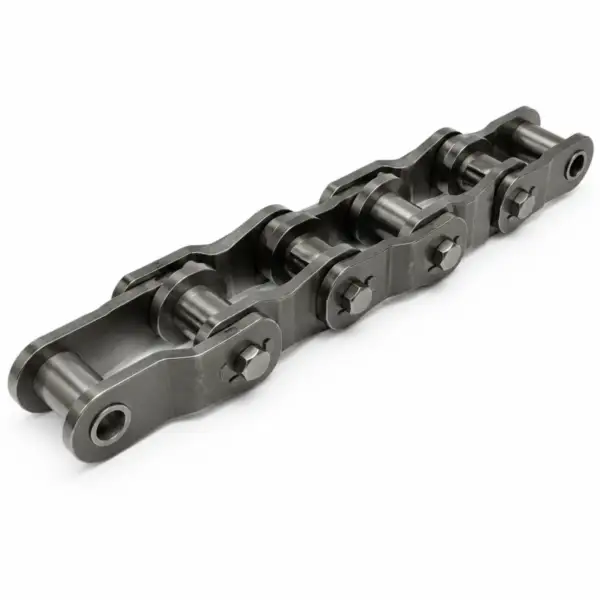
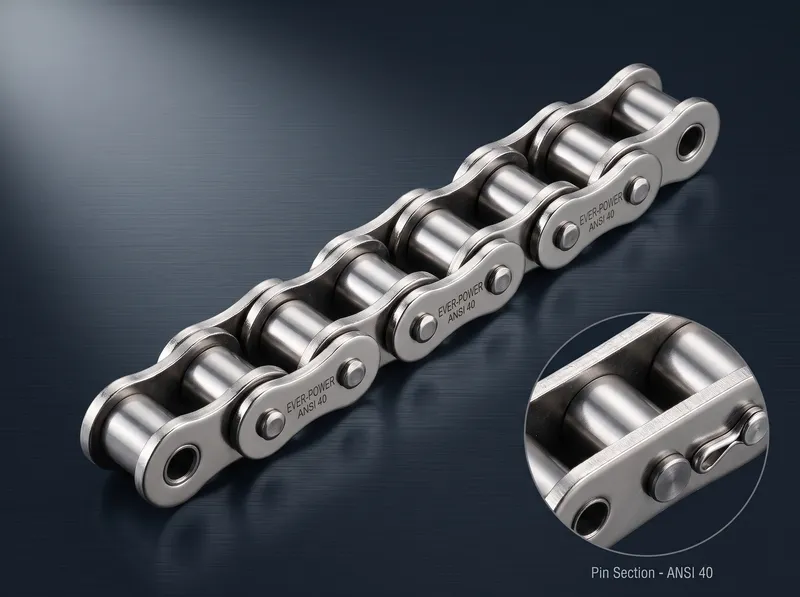
Cast iron sprockets are stock bore as standard — bore machined to your shaft diameter on order. All sizes up to 12B are also available from our taper bore European range in cast iron (-CI suffix). For the small-tooth-count carbon steel equivalent covering Z=8 to Z=57, see our European standard stock bore sprockets. Pair with European standard roller chain in DIN 8187 for a matched, factory-direct drive.
⚙️ Cast iron is the right choice when:
- Sprocket diameter exceeds 200 mm — casting is cheaper than machining from solid bar
- Environment is abrasive, dusty or poorly lubricated
- Drive is slow-speed (<50 rpm at sprocket) and heavily loaded
- Vibration damping is needed — grey iron absorbs shock better than steel
- Cost is the primary driver on a non-critical, slow drive
Why Grey Cast Iron Works in Abrasive Environments
The performance advantage of GG25 cast iron over carbon steel in dirty, dry or abrasive drives is a consequence of its microstructure — not its hardness. Understanding the mechanism helps in selecting the right material for each application.
Graphite Lamellae — Built-In Lubrication
In grey cast iron, carbon precipitates as flake graphite (lamellar graphite) distributed throughout the iron matrix. At the tooth contact surface, these graphite flakes are exposed as the surface wears in — they act as solid lubricant pockets, releasing graphite into the contact zone under pressure. This self-lubricating behaviour is the key property that makes cast iron outperform carbon steel on poorly lubricated or contaminated drives.
Micro-Abrasion Resistance
A polished carbon steel tooth flank offers no resistance to fine abrasive particles — quartz dust, cement grit, grain chaff and limestone fines all act as micro-abrasives that rapidly score the smooth surface. The graphite-interrupted surface of GG25 provides a degree of resistance to this mechanism: abrasive particles tend to embed in the graphite pockets rather than scoring a continuous groove across the tooth face.
Vibration Damping
Grey cast iron has a significantly higher specific damping capacity than carbon steel — typically 20–25× higher. The graphite flakes act as internal crack-initiators that absorb vibrational energy by microcrack propagation along the graphite-matrix interface. This means a cast iron sprocket on a pulsating or shock-loaded drive runs measurably quieter than a steel equivalent at the same speed, and transmits less vibration into the shaft and bearings.
Lower Cost at Large Diameters
For sprockets above ~200 mm diameter, producing the blank from a casting is significantly cheaper than machining from a solid bar or forging. A 500 mm diameter cast iron sprocket blank requires a fraction of the material cost and machining time of an equivalent solid C45 bar blank. At Z=95 in 16B (780 mm tip diameter), cast iron is the only practical and economical production route for standard quantities.
⚠️
Speed limitation: Grey cast iron is brittle — it has essentially zero ductility and will fracture rather than deform under impact. Cast iron sprockets must not be used on drives above 50 rpm at the sprocket, or on drives with heavy shock loading (e.g. crusher start-up). For higher-speed or shock-load applications, use the carbon steel range. Cast iron is a slow-speed, steady-load, abrasive-environment material choice.
列键: Z = tooth count | de = tip dia. (mm) | dp = pitch circle dia. (mm) | dm = hub dia. (mm) | D1/D2/D3 = stock bore max for simplex/duplex/triplex (mm) | A = hub width (mm) | Material: GG22–GG25 grey cast iron, surface phosphated
Cast Iron Sprocket Specifications
06B-1/2/3 | Pitch 9.525 mm | Roller Ø 6.35 mm
| Z | de (mm) | dp(毫米) | dm (mm) | D1 Simplex (mm) | D2 Duplex (mm) | D3 Triplex (mm) | A(毫米) |
|---|---|---|---|---|---|---|---|
| 38 | 119.5 | 115.35 | 70 | 20 | 20 | 24 | 32 / 40 / 56 |
| 45 | 140.7 | 136.55 | 70 | 20 | 20 | 24 | 32 / 40 / 56 |
| 57 | 176.9 | 172.91 | 70 | 20 | 20 | 24 | 32 / 40 / 56 |
| 76 | 234.9 | 230.49 | 70 | 20 | 20 | 24 | 32 / 40 / 56 |
| 95 | 292.5 | 288.08 | 80 | 20 | 20 | 24 | 40 / 45 / 56 |
| 114 | 349.6 | 345.68 | 80 | 20 | 20 | 24 | 40 / 45 / 56 |
| 150 | 459.2 | 454.82 | 90 | 24 | 24 | 24 | 45 / 50 / 60 |
16B-1/2/3 | Pitch 25.40 mm | Roller Ø 15.88 mm
| Z | de (mm) | dp(毫米) | dm (mm) | D1 Simplex (mm) | D2 Duplex (mm) | D3 Triplex (mm) | A(毫米) |
|---|---|---|---|---|---|---|---|
| 30 | 254.0 | 243.00 | 110 | 30 | 40 | 40 | 65 / 75 / 90 |
| 38 | 320.0 | 307.59 | 110 | 30 | 40 | 45 | 65 / 75 / 100 |
| 57 | 474.0 | 461.08 | 125 | 35 | 40 | 45 | 70 / 90 / 100 |
| 76 | 627.0 | 614.65 | 140 | 35 | 40 | 45 | 80 / 95 / 110 |
| 95 | 781.0 | 768.22 | 140 | 40 | 45 | 50 | 80 / 95 / 110 |
| 114 | 933.0 | 921.81 | 140 | 40 | 45 | 50 | 80 / 95 / 115 |
24B-1/2/3 | Pitch 38.10 mm | Roller Ø 25.40 mm
| Z | de (mm) | dp(毫米) | dm (mm) | D1 Simplex (mm) | D2 Duplex (mm) | D3 Triplex (mm) | A(毫米) |
|---|---|---|---|---|---|---|---|
| 30 | 379.5 | 364.50 | 130 | 40 | 40 | 60 | 85 / 95 / 150 |
| 38 | 476.2 | 461.39 | 140 | 45 | 45 | 60 | 90 / 100 / 150 |
| 57 | 706.5 | 691.63 | 160 | 45 | 55 | 70 | 100 / 110 / 150 |
| 76 | 936.9 | 921.98 | 170 | 45 | 55 | 70 | 100 / 120 / 150 |
08B, 10B, 12B and 20B tables available — contact us. Non-catalogue tooth counts and custom hub configurations machined to drawing for OEM production orders. Maximum bore D1 is for the simplex hub — duplex and triplex maximum bores are smaller due to narrower hub. Specify your required bore, chain size, tooth count and strand when requesting a quote.
应用程序
Quarry, Mining & Cement Plant
Slow primary conveyor drives in stone crushing, limestone quarrying and cement raw material handling. Large-diameter cast iron sprockets on 16B and 24B chain are standard for bucket elevator drives and pan conveyor head drives in these environments. The combination of abrasion resistance, vibration damping and low cost at large diameter makes cast iron the material of choice in these applications. See the full 链轮范围 for other drive options.
Grain Handling & Agricultural Processing
Grain elevator leg drives, grain cleaner chain drives and feed mill conveyor systems use large-diameter cast iron sprockets extensively. The abrasive nature of grain chaff, dust and grit makes cast iron's graphite surface far more wear-resistant than polished carbon steel under the poorly lubricated conditions typical of these drives. Z=57 to Z=95 in 10B and 12B are common specifications in this sector.
Woodworking & Forestry Equipment
Sawmill log deck chains, debarker conveyors and chip conveyor drives in saw dust and bark chip environments. Sawdust is a fine abrasive that destroys polished steel tooth flanks rapidly — cast iron's self-lubricating graphite surface resists this well. The vibration damping of cast iron also helps in sawmill drives where the chain drive transmits the pulsating torque of a circular saw or bandsaw.
配套链条及相关产品
常见问题解答
客户评价
★★★★★
"We run 12B-1 chain on large cast iron sprockets Z=76 on our limestone elevator drives. Previous carbon steel sprockets at this size were outrageously expensive and wore out in 8 months in our dusty conditions. Korea Ever-Power GG25 cast iron at the same size has now run 22 months and the tooth profile is still within gauge. The phosphated surface retains chain oil far better than machined steel."
G.B., Maintenance Engineer
Italy – Limestone Processing Plant
★★★★★
"We needed 16B-2 duplex cast iron sprockets at Z=95 for a slow bucket elevator drive — 933 mm tip diameter. Nobody else quoted from stock inside 8 weeks. Korea Ever-Power produced and shipped in 4 weeks. The casting quality and bore tolerance were correct. We have since placed a standing order for annual supply."
D.F., Procurement Manager
Poland – Grain Elevator OEM
★★★★★
"Our sawmill uses 10B-1 chain on Z=57 cast iron sprockets throughout the log deck and green chain conveyor system. Sawdust here is extremely abrasive. After three years with Korea Ever-Power GG25 sprockets, we have had no tooth profile failures. Previously steel sprockets needed replacement every 18 months. The vibration reduction was also noticeable — the drive runs markedly quieter."
H.L., Plant Manager
Sweden – Sawmill

其他信息
| 编辑 | CXM |
|---|
相关产品
-
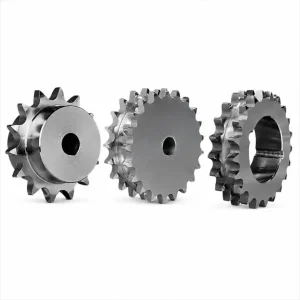
Double Sprockets for Two Single Chains Asian Standard
-
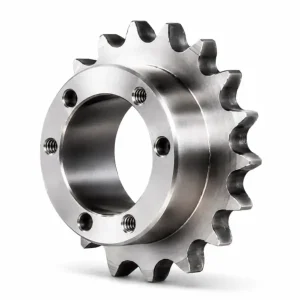
Sprockets with QD Bushings American Standard
-
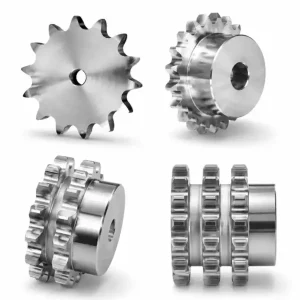
Double Pitch Sprockets American Standard
-
Double Sprockets for Two Single Chains American Standard
-
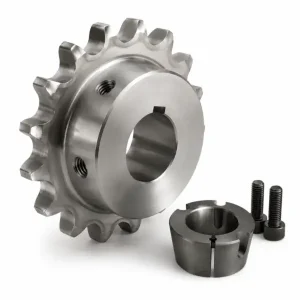
Taper Bore Sprockets American Standard
-
Steel Stock Bore Sprockets American Standard
-
滚珠轴承惰轮(欧洲标准)| 自由运转张紧轮(DIN 8187)
-
欧洲标准链轮和盘轮 | 单联、双联、三联 DIN 8187