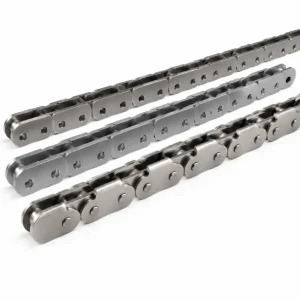
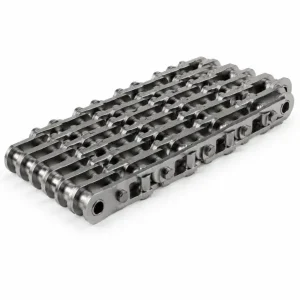
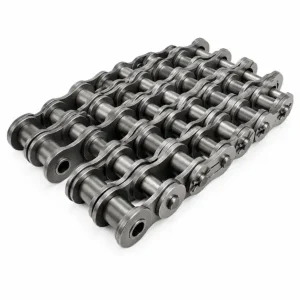
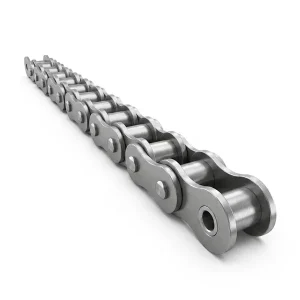
Ланци за пренос са зглобним зглобовима велике снаге
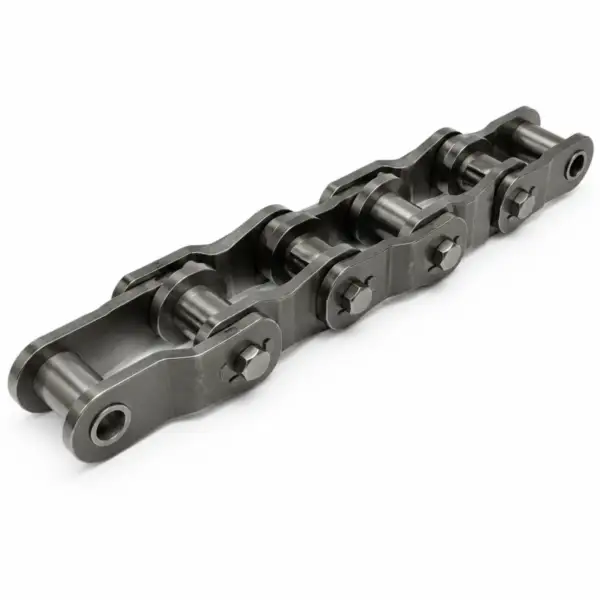
Ланци са кољенастим зглобовима EP-MXS, EP-SS, EP-2512, EP-2510, EP-R и специјалне серије за захтевне преносе снаге код виљушкара, индустријских возила, пољопривредних машина и тешких машина. Корак ланца од 42,01 мм до 78,10 мм. Просечна затезна чврстоћа до 560 kN.
30+ модела
MXS / SS / 2512 / 2510
42,01 до 78,10 мм
Распон тона
До 562 кН
Просечна затезна чврстоћа
ИСО 9001
Сертификовани квалитет
Ланац са кољенастим зглобовима за тешке услове рада - Преглед производа
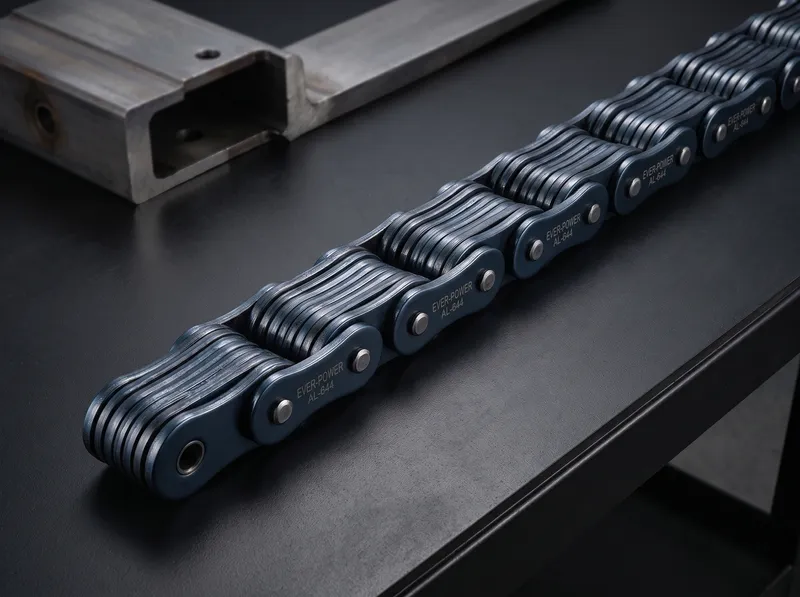
Вечна моћ ланци за пренос са кољенастим зглобовима велике носивости су специјализована породица ваљкастих ланаца дизајнираних за примене преноса снаге са великим оптерећењем и малом брзином у тешкој индустријској опреми. Дизајн са луфтастим кариком - такође познат као конструкција са офсет кариком или савијеним кариком - користи плоче карика које су савијене или нагнуте ка споља на положају отвора за клин, уместо конвенционалне равне плоче. Ова геометрија омогућава употребу клина и чауре већег пречника на истом кораку у поређењу са стандардним ланцем са равном плочом, што резултира већом површином лежишта споја и знатно већом отпорношћу на ломљење клина услед савијања под веома високим напонима који се јављају у овим применама.
Конструкција са кољенастим кариком такође има важну практичну предност: пошто су унутрашња и спољашња плоча истог кољенастог профила, а не два различита равна профила, ланац се може склопити и расклопити коришћењем стандардних спојних карика које су идентичне покретним карикама. Ово поједностављује одржавање на терену и смањује ризик од неправилне инсталације спојних карика. Стандардна спојна карика ваљкастог ланца (тип опружне осигураче или расцепке) користи плочу која се разликује од покретне унутрашње плоче, што може проузроковати проблеме ако се постави погрешна спојна карика. Ланци са кољенастим кариком у потпуности елиминишу овај проблем.
Асортиман EP са зглобним зглобовима обухвата четири основне серије. MXS серија (EP-MXS432, EP-MXS882, EP-MXS882F1, EP-MXS3011F1) покрива лаке до средње тешке примене са кољенастим зглобовима са кораком од 42 до 78 mm. СС серија (EP-SS2065, EP-SS588, EP-SS588F1, EP-SS588F2, EP-SS588F7, EP-SS568H, EP-SS568HF2, EP-SS568HF3, EP-SS568HF4) пружа стандардни распон средње тешких кољенастих зупчаника са кораком од 50,8 до 77,9 мм, који се широко користи у главним погонима виљушкара, погонима индустријских возила и примарним мењачима пољопривредних машина. Серија 2512 (EP-2512, EP-2512F2, EP-2512F3, EP-2512F4) покрива најтеже примене мењача за виљушкар и тешка возила са кораком од 77,9 mm. Серија 2510 (ЕП-2510, ЕП-2510Ф1, ЕП-2510Ф2, ЕП-2510Х) са кораком од 78,1 мм обезбеђује максималну носивост конфигурације са кољенастим зглобом у асортиману.
Ланци означени звездицом (*) у броју модела EP су ланци са чауром - ваљак је замењен чауром, а димензија d1 у табели спецификација односи се на спољашњи пречник чауре, а не на спољашњи ваљак. Ознаке суфикса F (F1, F2, F3, F4, F7) идентификују различите варијанте геометрије плоча које користе одређени произвођачи оригиналне опреме (OEM). Суфикс H означава варијанту тешке плоче са дебљим плочама карика за дужи век трајања на замор. Суфикс SH означава варијанту супер тешке плоче. Сви ланци са кољенастим карикама EP су произведени од легираног челика са термички обрађеним плочама, каљеним клиновима и чаурама и прецизно брушеним пречницима клинова. Преднапрезање се примењује на све склопљене ланце пре коначног мерења корака и отпреме.
Кључ димензије: P = Корак | d1 = Макс. пречник ваљка (ланац чауре: спољашњи пречник чауре) | b1 = Мин. унутрашња ширина између плоча | d2 = Макс. пречник клина | L = Макс. дужина клина | h2 = Дубина плоче | T = Дебљина плоче | Q = Мин. затезна чврстоћа kN/lbf | Q0 = Просечна затезна чврстоћа kN | q = Тежина kg/m | * = Ланац чауре | F = Варијантна геометрија плоче | H = Тешка плоча | SH = Супер тешка плоча
Спецификације ланца са зглобним карикама
Све димензије су у мм. Ланци означени са * су ланци са чахурама. Суфикси F, H, SH означавају геометрију плоче или варијанте тежине као што је горе описано.
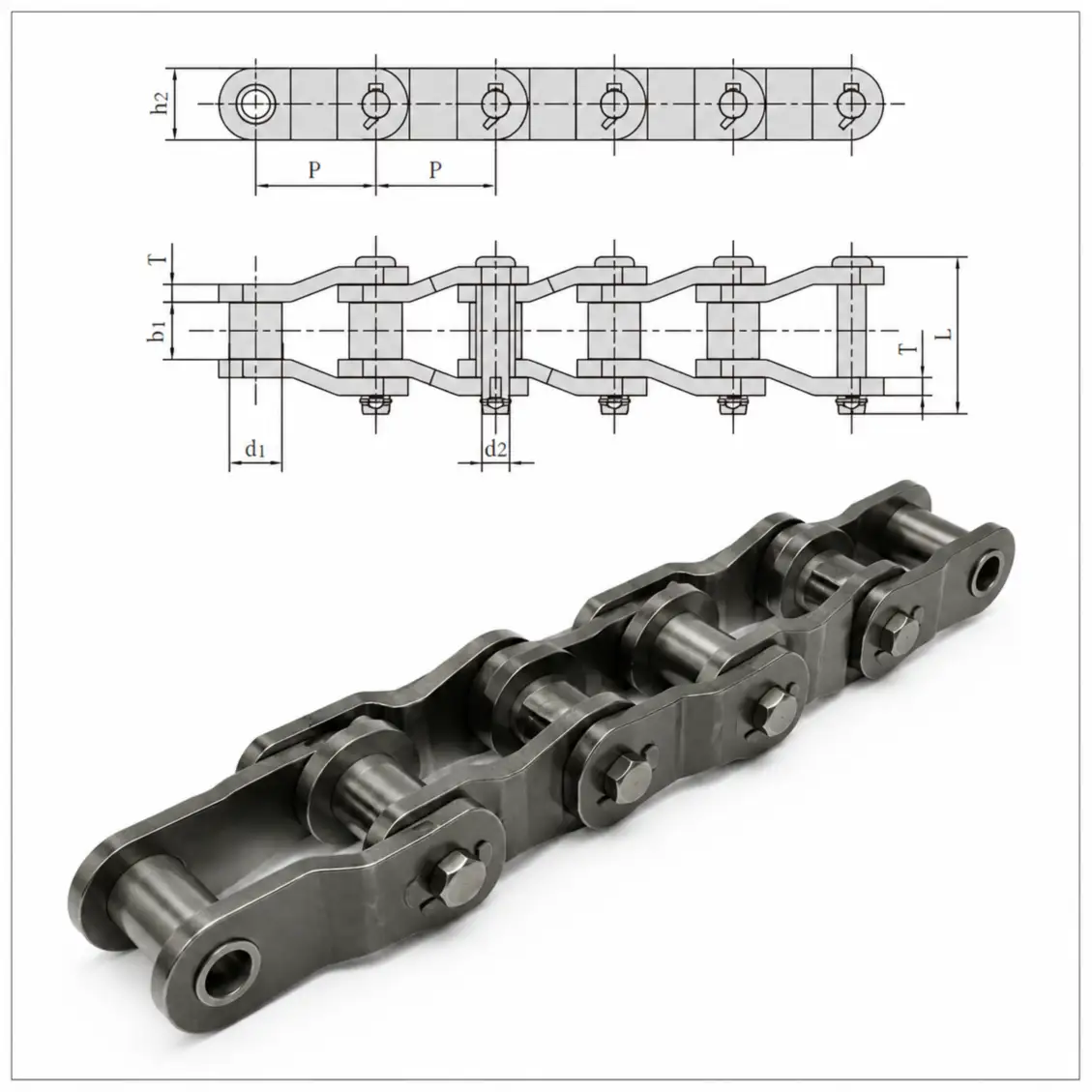
| ЕП модел | П (мм) | d1 max (mm) | b1 мин (мм) | d2 max (mm) | Д макс. (мм) | h2 (мм) | Т (мм) | Q мин (kN/lbf) | Q0 (kN) | q (кг/м²) |
|---|---|---|---|---|---|---|---|---|---|---|
| MXS серија | ||||||||||
| ЕП-МКС432 | 42.01 | 22.23 | 25.40 | 11.10 | 57.9 | 28.50 | 4.8 | 80.80/18363 | 88.0 | 5.65 |
| ЕП-МКС882 | 66.27 | 22.23 | 28.58 | 11.10 | 68.5 | 28.50 | 6.4 | 115.60/26272 | 124.8 | 5.30 |
| ЕП-МКС882Ф1 | 66.27 | 22.10 | 28.58 | 11.10 | 68.5 | 28.50 | 6.4 | 110.00/24728 | 121.0 | 5.39 |
| ЕП-*MXS3011F1 | 77.90 | 31.75 | 39.60 | 19.05 | 100.0 | 57.00 | 9.7 | 407.50/18363 | 468.0 | 17.68 |
| ЕП-*MXS882F2 | 66.27 | 22.23 | 28.58 | 11.10 | 66.6 | 28.50 | 6.4 | 115.60/25987 | 124.8 | 5.39 |
| Специјалне серије (1409F1, R3112, SS2065, 2010) | ||||||||||
| ЕП-1409Ф1 | 44.45 | 25.40 | 25.40 | 13.97 | 65.9 | 43.20 | 6.3 | 217.00/48782 | 238.7 | 9.65 |
| ЕП-Р3112 | 50.80 | 28.70 | 31.00 | 14.20 | 73.9 | 41.40 | 6.4 | 168.90/38385 | 185.0 | 10.70 |
| ЕП-Р3112Ф1 | 50.80 | 28.70 | 31.00 | 15.06 | 79.5 | 41.40 | 7.9 | 195.60/18363 | 225.0 | 12.23 |
| ЕП-СС2065 | 50.80 | 28.58 | 32.50 | 15.05 | 79.5 | 38.00 | 7.9 | 220.00/49998 | 242.0 | 12.14 |
| ЕП-2010 | 63.50 | 31.75 | 38.10 | 15.90 | 89.0 | 47.80 | 7.9 | 250.00/56818 | 275.0 | 13.53 |
| ЕП-2010Х | 63.50 | 31.75 | 31.75 | 15.88 | 97.0 | 41.50 | 9.5 | 250.00/56818 | 275.0 | 11.91 |
| ЕП-2010Ш | 63.50 | 31.75 | 38.10 | 15.88 | 97.0 | 41.50 | 9.5 | 300.00/68181 | 330.0 | 12.00 |
| Серија СС588 | ||||||||||
| ЕП-*СС588Ф4 | 66.27 | 22.23 | 30.40 | 11.11 | 60.0 | 32.00 | 4.8 | 90.00/20454 | 103.0 | 5.05 |
| ЕП-СС588 | 66.27 | 22.23 | 28.60 | 11.11 | 63.7 | 28.60 | 6.4 | 130.00/29545 | 144.0 | 5.46 |
| ЕП-СС588Ф1 | 66.27 | 22.23 | 27.00 | 11.11 | 62.0 | 28.60 | 6.4 | 88.90/20205 | 97.8 | 5.39 |
| ЕП-СС588Ф2 | 66.27 | 22.23 | 27.00 | 9.53 | 59.0 | 25.40 | 5.6 | 84.46/19195 | 91.2 | 4.26 |
| ЕП-СС588Ф7 | 66.27 | 22.35 | 26.90 | 11.20 | 60.0 | 28.70 | 4.8 | 80.00/17984 | 88.0 | 4.52 |
| *MX603 серија | ||||||||||
| ЕП-*MX603 | 76.20 | 22.50 | 38.00 | 14.00 | 88.0 | 40.00 | 8.0 | 147.00/33408 | 161.0 | 9.20 |
| Серија 2512 (П 77,90 мм) | ||||||||||
| ЕП-2512(MXS3011) | 77.90 | 41.28 | 39.60 | 19.05 | 100.0 | 57.00 | 9.7 | 340.00/77272 | 489.3 | 18.40 |
| ЕП-2512Ф2 | 77.90 | 41.28 | 38.50 | 19.05 | 103.4 | 60.00 | 10.0 | 400.00/90909 | 420.0 | 20.28 |
| ЕП-2512Ф3 | 77.90 | 41.28 | 40.00 | 18.60 | 104.2 | 46.70 | 11.0 | 340.00/77271 | 391.0 | 18.15 |
| ЕП-2512Ф4 | 77.90 | 41.28 | 39.60 | 19.05 | 110.0 | 60.00 | 12.0 | 407.50/92612 | 468.0 | 23.60 |
| Серија SS568H (P 77,90 mm) | ||||||||||
| ЕП-СС568Х | 77.90 | 41.30 | 39.70 | 19.05 | 97.6 | 57.00 | 9.5 | 460.00/103408 | 515.0 | 19.80 |
| ЕП-СС568ХФ2 | 77.90 | 31.75 | 39.70 | 19.05 | 98.5 | 57.00 | 9.5 | 447.00/101588 | 491.0 | 16.90 |
| ЕП-СС568ХФ3 | 77.90 | 41.30 | 39.70 | 19.05 | 104.1 | 57.00 | 11.0 | 489.30/111203 | 562.0 | 20.85 |
| ЕП-СС568ХФ4 | 77.90 | 41.30 | 39.70 | 19.05 | 100.0 | 57.00 | 10.0 | 490.00/110152 | 539.0 | 19.80 |
| Серија 2510 (P 78,10 mm) | ||||||||||
| ЕП-2510 | 78.10 | 31.75 | 36.90 | 16.00 | 94.8 | 40.00 | 8.0 | 271.00/61590 | 292.6 | 10.72 |
| ЕП-2510Ф1 | 78.10 | 31.75 | 36.60 | 16.00 | 88.9 | 38.10 | 8.0 | 124.50/28295 | 137.0 | 9.93 |
| ЕП-2510Ф2 | 78.10 | 31.75 | 36.60 | 15.75 | 88.0 | 38.10 | 8.0 | 225.00/51135 | 248.0 | 11.70 |
| ЕП-2510Х | 78.10 | 31.75 | 36.90 | 16.50 | 95.3 | 45.00 | 9.5 | 280.40/63727 | 302.8 | 12.70 |

Апликације
Главни погони виљушкара
Ланци серије EP-SS588, EP-SS568H, EP-2512 и EP-2510 су примарна спецификација за главне погоне виљушкара и ланце јарбола. Погони виљушкара су међу најзахтевнијим за ланце - веома велико оптерећење при малој брзини, често окретање под пуним оптерећењем, изложеност контаминацији и захтев за веома дугим веком трајања између замена. Геометрија кољенасте везе обезбеђује велику површину лежаја зглоба потребну за постизање овог века трајања у компактној конфигурацији погона мењача виљушкара.
Пољопривредне машине
Ланци са кољенастим зглобовима серије EP-MXS432, EP-1409F1, EP-R3112 и EP-SS2065 за погоне бубњева вршидбе комбајна, погоне спушног транспортера хедера и погоне за пражњење бубњева за зрно. Ове примене комбинују повремене веома високе вршне моменте - посебно када бубањ обрађује густу површину усева - са потребом за компактном геометријом погона и дугим веком трајања поља. Дизајн са кољенастим зглобовима боље подноси ударна оптерећења од еквивалентних ланаца са равним плочама у овим условима.
Индустријска возила и грађевински погони
Серије EP-2010, EP-2010H, EP-2010SH, EP-2512 и EP-SS568H за коначне погоне индустријских возила, главне ланце дохватних слагача, погоне за окретање руковалаца контејнерима и ланчане погоне тешких грађевинских постројења. Ове примене захтевају веома високу затезну чврстоћу у ланцу који мора да се уклопи у постојећу геометрију ланчаника. EP-SS568HF3 са просечном затезном чврстоћом од 562 kN је посебно погодан за најтеже примене у овој категорији.
Одговарајући ланчаници и други типови ланаца
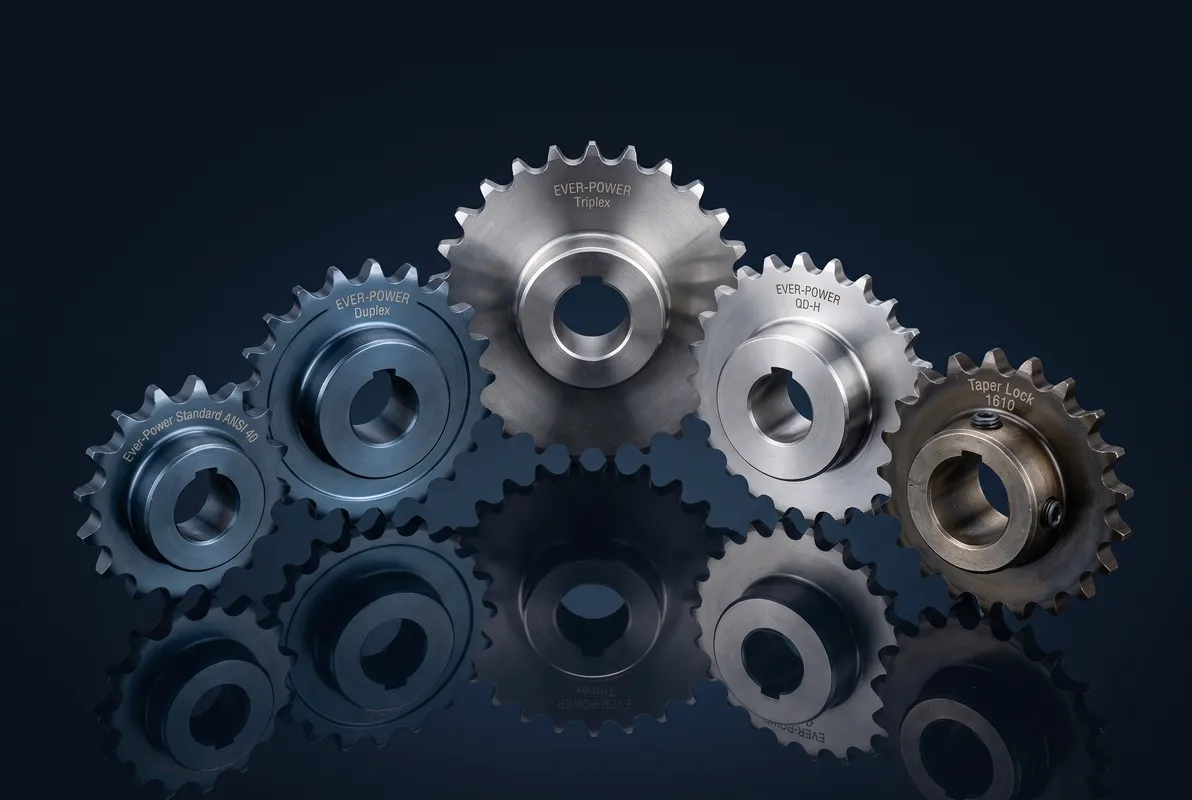
Одговарајући ланчаници за серију ланца са кољенастим зглобовима EP - укључујући ланчанике погона виљушкара од C45 и легираног челика са профилима зубаца усклађеним са OEM - доступни су преко наше партнерске веб странице sprocket-chain.net.
Погледајте одговарајуће ланчанике →
Остали ланци
Ланци од нерђајућег челика
Ваљкасти ланци SUS304 и SUS316L за прехрамбену, фармацеутску и корозивну индустрију.
Пољопривредни ланци
Серије CA, CC и S за комбајне, балирке и машине за руковање усевима. Стандард ISO 487.
Инжењерски ланци
WH заварени челични, ливени и округли ланци за транспорт цемента, рударства и тешких постројења.
Често постављана питања
Шта кажу наши купци
★★★★★
„Управљамо флотом од 140 виљушкара са противтегом у три складишта. Прешли смо на ланце EP-SS568H за наше јединице од 7 тона пре две године. Просечан интервал замене ланца је порастао са 4.500 сати на 7.200 сати. Димензионална конзистентност је одлична - никада нисмо морали да подешавамо центре ланчаника након инсталације EP ланца.“
ДК, менаџер возног парка
Јужна Кореја - Логистички центар
★★★★★
„Одржавамо комбајне за велику задругу. Ланци EP-SS2065 за погоне бубњева вршидбе су нам омогућили две пуне жетве без замене. Претходни ланци од другог добављача су морали да се замене средином сезоне у првој години. EP ланци су показали издужење од 1,4% на крају друге жетве, што је и даље у границама.“
МТ, менаџер услуга
Француска - Продавац пољопривредних машина
★★★★★
„Били су нам потребни ланци EP-2512F4 као OEM замена за флоту тешких виљушкастих слагача. EP је идентификовао ланац из нашег узорка у року од 3 радна дана, потврдио димензионалну подударност и испоручио 8 комплетних дужина кола у року од 12 радних дана. Ланци су се уклопили без подешавања. Сада имамо EP-2512F4 на нашој листи одобрених добављача за ову примену.“
ЈЛ, менаџер набавке
Холандија - Оператор лучког терминала
★★★★★
Дистрибуирамо делове за виљушкаре широм Југоисточне Азије. EP ланци са зупчастим карикама покривају преко 85% модела које срећемо на терену. Конзистентност од серије до серије је кључна предност - наши техничари знају да ће EP ланац одговарати из првог пута без мерења сваког појединачног ланца. Та поузданост вреди више од мале разлике у цени.
CS, технички директор
Тајланд - Дистрибутер делова за виљушкаре

Додатне информације
| Уредник | Cxm |
|---|