Rodas dentadas em aço inoxidável, padrão europeu | 304L e 316L DIN 8187 ISO R606
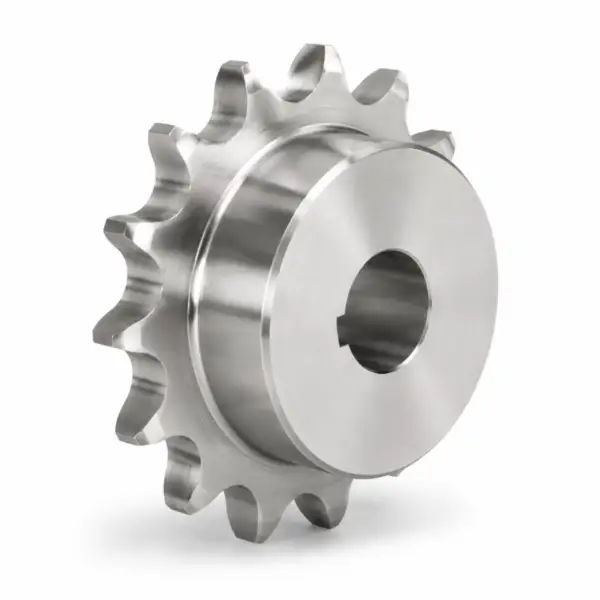
Rodas dentadas Simplex em aço inoxidável, conforme DIN 8187 / ISO R606, em AISI 304L (SUS304L). Tamanhos de corrente de 06B a 16B, com número de dentes de Z=12 a Z=57. Furo padrão. Resistentes à corrosão para processamento de alimentos, indústria farmacêutica, indústria química e ambientes de lavagem.
06B – 16B
Faixa de tamanho da corrente
Grau 304L
AISI 304L / SUS304L
Z=12 – 57
Faixa de contagem de dentes
ISO 9001
Qualidade Certificada
Rodas dentadas de aço inoxidável – Visão geral do produto
As rodas dentadas de aço inoxidável da Korea Ever-Power são fabricadas em aço inoxidável austenítico AISI 304L (SUS304L) com perfil de dente DIN 8187 / ISO R606 — a mesma geometria de dente da linha de aço carbono, garantindo encaixe perfeito em qualquer roda dentada compatível. Corrente de rolos padrão europeuO aço inoxidável 304L é a especificação padrão para processamento de alimentos, indústria farmacêutica, bebidas e ambientes químicos em geral, onde o aço carbono padrão corroeria e contaminaria o produto ou processo.
A principal diferença entre o aço 304 e o 304L reside no teor de carbono. O aço 304 padrão contém até 0,08% de carbono; o 304L é limitado a um máximo de 0,03%. O menor teor de carbono previne a sensibilização — a precipitação de carboneto de cromo nos contornos de grão durante a soldagem ou exposição a altas temperaturas — que, no aço 304 padrão, cria zonas com baixo teor de cromo, suscetíveis à corrosão intergranular. Para rodas dentadas que serão soldadas em estruturas fabricadas ou operadas em altas temperaturas, o 304L é a especificação correta, em vez do 304 padrão.
Todas as rodas dentadas desta gama são fornecidas com furo padrão (furo não acabado) como padrão. O furo é fornecido pronto para usinagem de acordo com o diâmetro do eixo, chaveta e tolerância especificados. Para aplicações na indústria alimentícia, onde superfícies usinadas mínimas são preferíveis, especifique um furo acabado com o diâmetro do furo no momento do pedido — o furo acabado usinado em aço inoxidável 304L está disponível para encomenda nos tamanhos de furo padrão listados na tabela de especificações.
Para ambientes com exposição a cloretos — como spray marinho, salmoura, produtos de limpeza à base de cloro ou produtos químicos com compostos de haletos — Aço inoxidável 316L (SUS316L com 2–3% molibdênio) Oferece resistência significativamente melhor à corrosão por pites e frestas. Rodas dentadas em aço inoxidável 316L estão disponíveis sob encomenda — entre em contato conosco com suas especificações. Combine qualquer uma das classes com as respectivas rodas dentadas. Corrente de rolos em aço inoxidável SUS304 ou SUS316 Para um sistema de transmissão totalmente inerte, sem metal ferroso no caminho de contato da corrente.
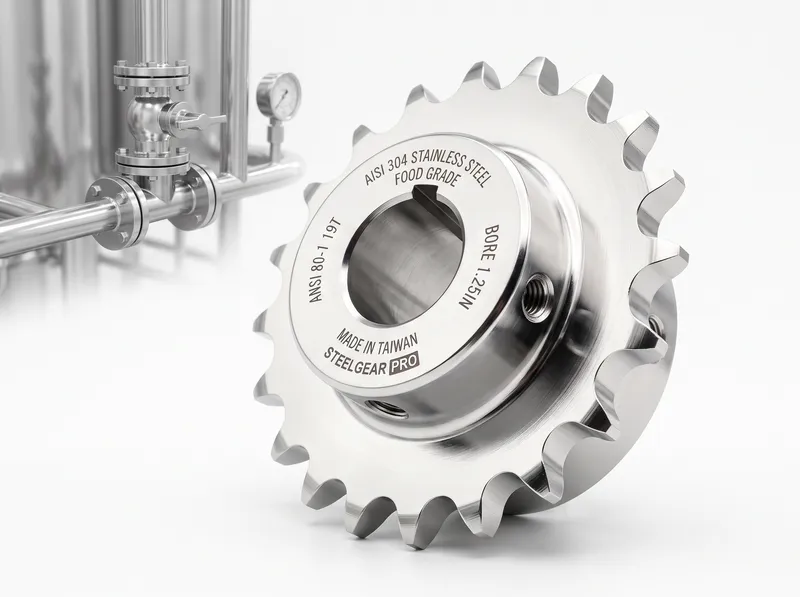
304L ou 316L — Qual grau de aço sua candidatura precisa?
Os dois tipos de aço inoxidável mais comuns para engrenagens atendem a diferentes ambientes de corrosão. Especificar o tipo errado é um erro comum e dispendioso — o aço inoxidável 304L corrói em ambientes com cloretos, enquanto o 316L resiste sem dificuldade.
AISI 304L / SUS304L
18% Cr · 8% Ni · ≤ 0,03% C
✔ Utilize para:
- Processamento de alimentos (secos e úmidos, sem halogênios)
- Transportadores para salas limpas e indústria farmacêutica
- Fábrica de engarrafamento de bebidas e laticínios
- Substância química geral (sem cloreto)
- Ambientes de água doce e umidade
- Lavar com detergente (sem alvejante)
✖ Evite para:
- Exposição à água do mar ou à maresia
- Lavagem com hipoclorito (água sanitária)
- Ambientes de salmoura ou conservas
- Contato com ácido clorídrico ou fluorídrico
AISI 316L / SUS316L — sob encomenda
16% Cr · 10% Ni · 2% Mo · ≤ 0,03% C
✔ Utilize para:
- Ambientes marinhos e costeiros
- Hipoclorito (água sanitária) e lavagem com cloro
- Processamento de salmoura e salmoura (peixe, carne, laticínios)
- Piscina e estação de tratamento de água
- Fábrica química com compostos de haleto
- Qualquer aplicação em que o aço inoxidável 304L apresente corrosão superficial.
A adição de molibdênio melhora drasticamente a resistência à corrosão por cloretos — a principal vantagem em relação ao aço 304L.
Fornecimento padrão: Correntes AISI 304L (SUS304L) em estoque. Correntes 316L disponíveis sob encomenda — entre em contato conosco informando o tamanho da corrente, o número de dentes e a quantidade desejada. Certificados de teste de fábrica (EN 10204 3.1) disponíveis para ambas as ligas mediante solicitação.
Legenda da dimensão: Z = número de dentes | de = diâmetro da ponta (mm) | dp = diâmetro do círculo primitivo (mm) | dm = diâmetro máximo do cubo (mm) | D1 = diâmetro máximo do furo central (mm) | A = largura do cubo (mm) | Material: aço inoxidável AISI 304L (SUS304L) como padrão
Especificações das rodas dentadas de aço inoxidável — 06B a 16B
Todas as configurações simplex (-1) mostradas. Material: aço inoxidável AISI 304L (SUS304L). Perfil do dente DIN 8187 / ISO R606.
| Tamanho da corrente | Passo (mm) | Z (Dentes) | de (mm) | dp (mm) | dm (mm) | D1 máx. (mm) | A (mm) |
|---|---|---|---|---|---|---|---|
| 06B-1 | Passo 9,525 mm | Diâmetro do rolete 6,35 mm | Largura do dente h1 5,3 mm | |||||||
| 06B-1 | 9.525 | 12 | — | — | 28 | 10 | 25 |
| 06B-1 | 9.525 | 13 | 43.0 | 39.79 | 28 | 10 | 25 |
| 06B-1 | 9.525 | 15 | 49.3 | 45.81 | 34 | 10 | 25 |
| 06B-1 | 9.525 | 17 | 55.3 | 51.83 | 40 | 10 | 28 |
| 06B-1 | 9.525 | 19 | 61.3 | 57.87 | 43 | 10 | 28 |
| 06B-1 | 9.525 | 25 | 80.0 | 76.00 | 57 | 12 | 30 |
| 08B-1 | Passo 12,70 mm | Diâmetro do rolete 8,51 mm | Largura do dente h1 7,2 mm | |||||||
| 08B-1 | 12.70 | 13 | 53.0 | 49.07 | 33 | 10 | 28 |
| 08B-1 | 12.70 | 17 | 65.9 | 61.09 | 45 | 10 | 28 |
| 08B-1 | 12.70 | 19 | 73.6 | 65.10 | 50 | 12 | 28 |
| 08B-1 | 12.70 | 25 | 105.8 | 101.33 | 70 | 14 | 28 |
| 08B-1 | 12.70 | 38 | 158.6 | 153.80 | 80 | 16 | 30 |
| 10B-1 | Passo 15,875 mm | Diâmetro do rolete 10,16 mm | Largura do dente h1 9,1 mm | |||||||
| 10B-1 | 15.875 | 13 | 73.0 | 66.32 | 47 | 12 | 30 |
| 10B-1 | 15.875 | 17 | 93.0 | 86.39 | 60 | 12 | 30 |
| 10B-1 | 15.875 | 19 | 103.3 | 96.45 | 75 | 14 | 30 |
| 10B-1 | 15.875 | 25 | 134.0 | 126.66 | 90 | 16 | 35 |
| 12B-1 | Passo 19,05 mm | Diâmetro do rolo 11,91 mm | Largura do dente h1 11,1 mm | |||||||
| 12B-1 | 19.05 | 13 | 87.5 | 79.59 | 58 | 16 | 35 |
| 12B-1 | 19.05 | 17 | 111.5 | 103.67 | 80 | 16 | 35 |
| 12B-1 | 19.05 | 25 | 165.0 | 152.0 | 90 | 20 | 40 |
| 16B-1 | Passo 25,40 mm | Diâmetro do rolo 15,88 mm | Largura do dente h1 17,0 mm | |||||||
| 16B-1 | 25.40 | 13 | 117.0 | 106.12 | 78 | 16 | 40 |
| 16B-1 | 25.40 | 17 | 149.0 | 138.22 | 100 | 19 | 45 |
| 16B-1 | 25.40 | 19 | 157.0 | 146.28 | 100 | 20 | 45 |
| 16B-1 | 25.40 | 25 | — | — | 110 | 20 | 50 |
A gama completa abrange Z=12 a Z=57 para 06B; Z=13 a Z=57 para 08B–16B. Números de dentes intermediários disponíveis. Aço inoxidável 316L disponível sob encomenda em todos os tamanhos — entre em contato conosco para obter preços e prazos de entrega. Certificados de teste de fábrica (EN 10204 3.1) disponíveis mediante solicitação.
Guia rápido de resistência química
Ambientes comuns encontrados em indústrias que utilizam rodas dentadas de aço inoxidável — e a classe apropriada para cada um.
| Ambiente/Médio | 304L | 316L | Notas |
|---|---|---|---|
| Água doce, umidade, condensação | ✔ OK | ✔ OK | 304L é adequado para a maioria dos ambientes úmidos de fábricas de alimentos. |
| Lavagem com detergente neutro | ✔ OK | ✔ OK | Limpeza padrão de fábricas de alimentos com detergente de pH neutro |
| Lavagem com hipoclorito (água sanitária) | ✖ Risco | ✔ OK | Os íons de cloro causam corrosão por pite no aço inoxidável 304L — utilize o aço inoxidável 316L em instalações que recebem lavagem com água sanitária. |
| Salmoura (peixe, carne, laticínios) | ✖ Evite | ✔ OK | O teor de molibdênio do aço inoxidável 316L proporciona resistência essencial aos cloretos. |
| Ácidos alimentares (acético, cítrico, lático) | ✔ OK | ✔ OK | Ácidos orgânicos diluídos à temperatura ambiente — ambos os graus de pureza são adequados. |
| CIP farmacêutico (ácido cítrico) | ✔ OK | ✔ OK | Limpeza CIP padrão com ácido cítrico — 304L adequados |
| Ar salgado marinho/costeiro | ✖ Evite | ✔ OK | A névoa salina causa corrosão por pite no aço inoxidável 304L em poucas semanas — é necessário o uso do aço inoxidável 316L. |
| Ácido sulfúrico diluído (<10%, ambiente) | ⚠ Atenção | ⚠ Atenção | A taxa de corrosão depende muito da temperatura e da concentração — consulte um engenheiro. |
Aplicações
Processamento e embalagem de alimentos
A principal aplicação das rodas dentadas de aço inoxidável 304L é em processos de fabricação de carne, panificação, confeitaria, engarrafamento e enlatamento de produtos químicos — em qualquer situação em que a corrente e a roda dentada estejam em contato com alimentos ou sujeitas a lavagens frequentes. O aço inoxidável 304L é a especificação padrão para acionamentos de esteiras transportadoras em fábricas de alimentos, de acordo com a maioria das normas europeias de segurança alimentar. Para aplicações em salmoura de peixe e carne, e lavagem com água sanitária, o aço inoxidável 316L é necessário. Consulte nossa lista completa. gama completa de rodas dentadas para outras opções compatíveis com alimentos.
Indústria Farmacêutica e Salas Limpas
Em ambientes regulamentados pelas Boas Práticas de Fabricação (GMP), não há necessidade de geração de partículas provenientes da corrosão de superfícies metálicas. As rodas dentadas de aço inoxidável com passivação por ácido cítrico atendem aos requisitos da FDA 21 CFR e das GMP da UE para componentes de máquinas que não entram em contato com o produto em salas limpas classificadas e áreas de fabricação farmacêutica. Não há risco de lascas ou desprendimento de revestimento no produto. Compatível com CIP e SIP em temperaturas abaixo de 150 °C.
Usina de Tratamento Químico e de Água
Acionamentos de correias transportadoras em plantas de mistura química, tratamento de água, peneiramento de efluentes e sistemas de dosagem onde o acionamento por corrente está exposto a respingos químicos ou atmosferas agressivas. Aço inoxidável 304L para ambientes químicos em geral; aço inoxidável 316L para dosagem de cloro ou produtos químicos halogenados. Entre em contato conosco com as especificações do seu processo para uma recomendação de grau de aço.
Correntes e produtos relacionados correspondentes
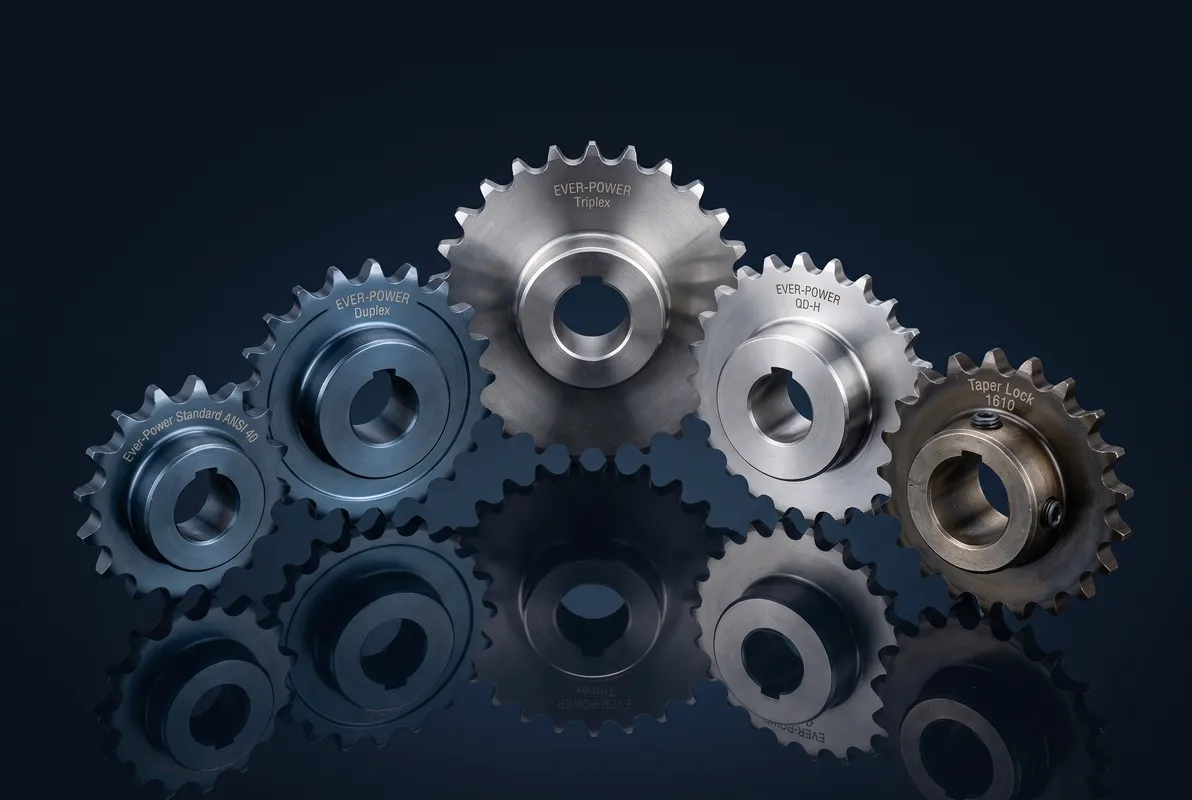
Aço carbono – Norma europeia
C45 com flancos de dentes endurecidos. 03B–24B, simplex a triplex. Para acionamentos secos e não corrosivos, onde a máxima vida útil dos dentes é prioridade.
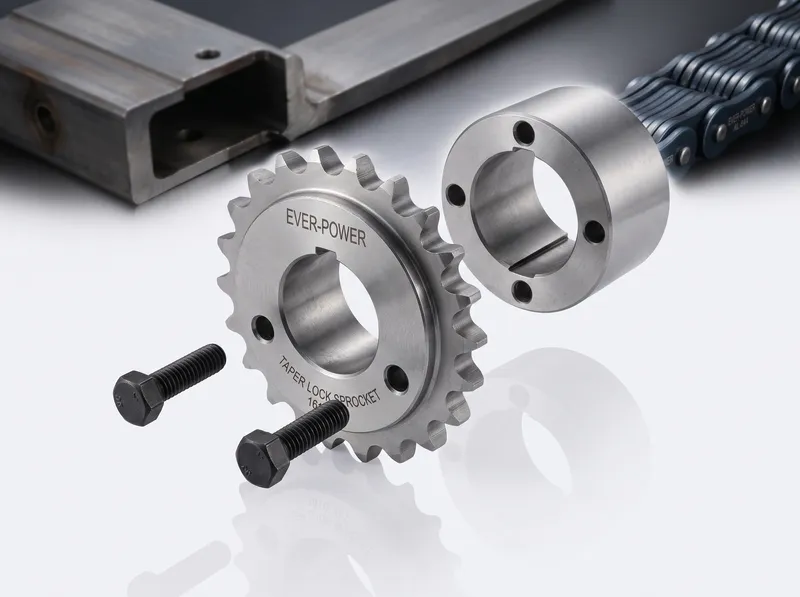
Diâmetro interno acabado – Norma Europeia
Furação prévia com tolerância H7, chaveta e parafuso de fixação. 06B–20B, diâmetro do furo de 10–100 mm. Disponível em aço inoxidável 304L sob encomenda.
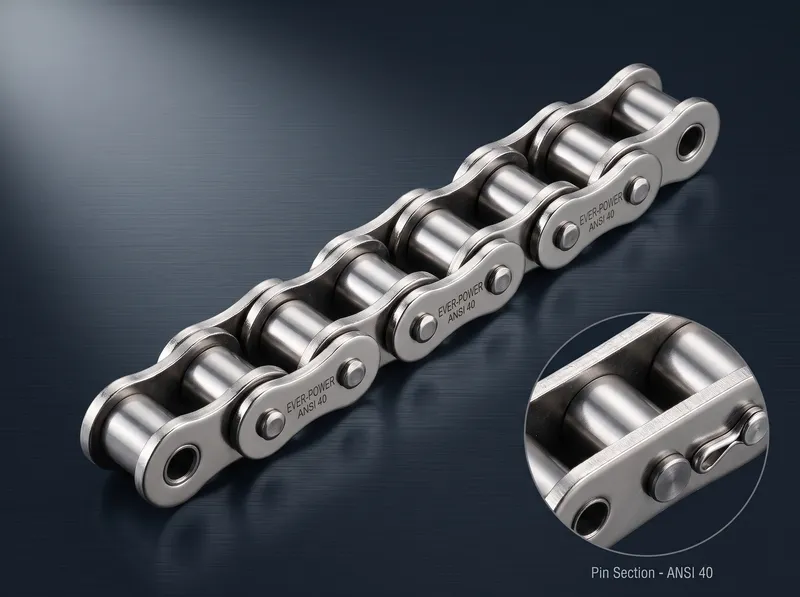
Correntes de transmissão
Correntes de rolos padrão europeu das séries A e B. Passo de 9,525 a 38,1 mm, simplex a triplex. Versões padrão e reforçada.
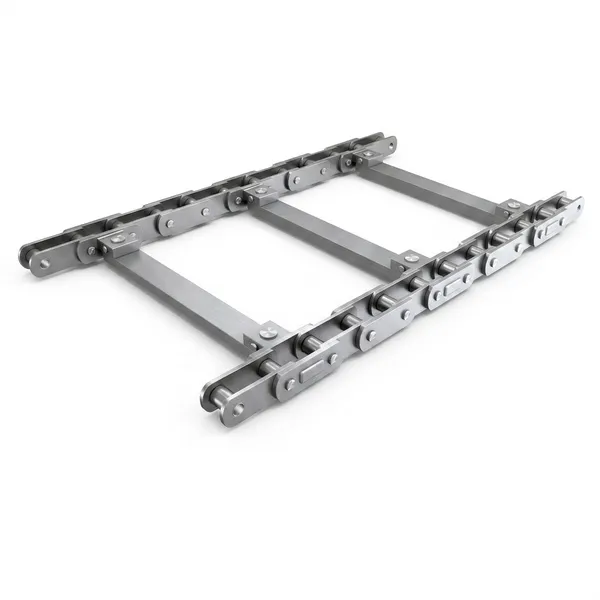
Correntes de Engenharia
Correntes soldadas de aço, fundidas e forjadas para aplicações de transporte pesado em fábricas de cimento, aço, mineração e produtos químicos.
Todas as rodas dentadas
Veja a gama completa de rodas dentadas →
Perguntas frequentes
O que dizem nossos clientes
★★★★★
"Operamos quatro linhas de processamento de carne com lavagem diária com água sanitária. Há dois anos, trocamos as rodas dentadas coreanas Ever-Power 316L por rodas dentadas de aço inoxidável 304L de outros fornecedores, após repetidas falhas por corrosão. Desde a mudança, não tivemos mais problemas de corrosão. A liga 316L, combinada com a corrente SUS316 correspondente, resolveu completamente nosso problema de corrosão."
PH, Gerente de Engenharia
Dinamarca – Processamento de Carne
★★★★★
"Especificamos rodas dentadas de aço inoxidável 304L da Korea Ever-Power para todas as nossas montagens de transportadores farmacêuticos. Recebemos certificados de fábrica EN 10204 3.1 com o primeiro pedido e eles têm se mantido consistentes em todas as entregas subsequentes. Nossa equipe de validação aceita a documentação sem testes adicionais."
SM, Engenheiro de Projetos
Alemanha – Fabricante de Equipamentos Farmacêuticos (OEM)
★★★★★
"Nossa linha de engarrafamento utiliza rodas dentadas de aço inoxidável 08B-1 na zona úmida. As rodas dentadas coreanas Ever-Power 304L estão em operação há 18 meses sem qualquer deterioração superficial, apesar da limpeza diária com ácido CIP e vapor. As rodas dentadas do fornecedor anterior apresentavam manchas superficiais após 6 meses. A diferença de qualidade é notável."
AR, Engenheiro de Manutenção
Holanda – Engarrafamento de Bebidas

Informação adicional
| Editor | Cxm |
|---|