Engineering Scope
Diagnostic Snapshot: Sprocket wobble and runout
Separate shaft runout, bearing movement, bore fit, bushing seating, hub distortion, and sprocket face error with staged dial-indicator checks before deciding which part to repair or replace. This article concentrates on sprocket wobble, radial runout, axial runout, shaft runout, bushing seating, and hub distortion as field-verifiable decision inputs.
For sprocket wobble and runout, keep chain engagement, shaft mounting, operating duty, and maintainability in the same decision record; use the current drawing whenever an exact limit is model-specific.
Field Reference
- Chain/tooth interface
- Confirm sprocket wobble, radial runout, and the mating chain dimensions before changing hardware.
- Shaft/hub interface
- Record axial runout and mounting details that control concentricity, axial position, or load transfer.
- Operating duty
- Document speed, load, shock, starts/reversals, contamination, washdown, and maintenance access relevant to sprocket wobble and runout.
- Verification record
- For sprocket wobble and runout, keep measured values, nominal drawing values, wear observations, and the final replacement requirement distinct in the service record.
Decision Principle
Release sprocket wobble and runout from measured interfaces, not appearance.
For sprocket wobble and runout, check the chain interface, shaft connection, duty, and installed geometry as separate acceptance items, then reconcile them in the final specification.
1. Wobble describes an effect, not a root cause
Visible side movement can come from the sprocket face, a bent shaft, loose bearing, off-center bushing, dirt under a shoulder, or a distorted hub. Record the evidence for wobble describes an effect, not a root cause beside the measured sprocket wobble. If axial runout is size- or supplier-dependent, carry the drawing reference into the purchase record. For component context, review sprocket runout inspection when the linked product family is relevant to the same chain-drive interface.
For procurement, express wobble describes an effect, not a root cause as verifiable data: chain standard, measured dimension, drawing reference, material condition, or operating requirement. Do not specify only ‘same as old.’
2. Measure the shaft reference first
If the shaft itself runs out, replacing the sprocket cannot eliminate the observed motion. Indicate the shaft near the sprocket seat and check bearing play. Treat measure the shaft reference first as a pass/fail interface: document radial runout, inspect the mating component, and use shaft runout to confirm the final operating fit.
For commissioning, define how measure the shaft reference first will be checked after installation: chain seating, runout, shaft clearance, tooth-side contact, rpm, or loaded inspection as applicable.
3. Separate radial from axial motion
Radial eccentricity changes chain tension once per revolution; axial wobble changes chain-line position. Both can exist simultaneously and require different measurements. A useful field note for sprocket wobble and runout pairs axial runout with bushing seating. That keeps the decision tied to the actual chain drive rather than a visual match. For component context, review industrial shaft and hub components when the linked product family is relevant to the same chain-drive interface.
Verification for sprocket wobble and runout: compare the field condition with nominal data and treat any difference that changes roller seating, shaft support, or service access as a release criterion.
4. Mounting systems introduce distinct failure modes
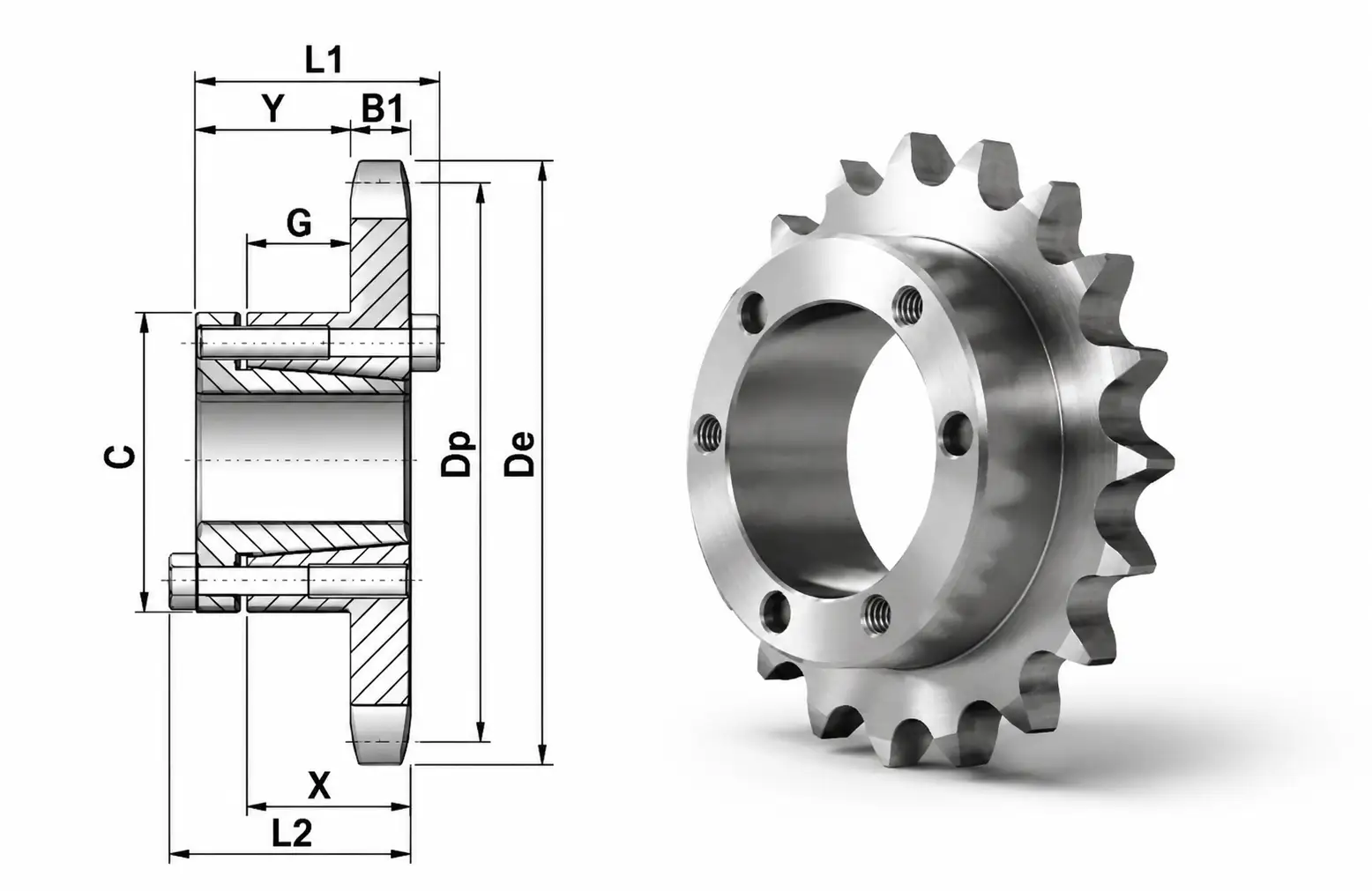
Finished bores can fret or become loose; taper bushings can seat unevenly; split sprockets can have joint error. Inspect the mounting style that is actually installed. For sprocket wobble and runout, use shaft runout as the primary field reference and compare it with hub distortion; resolve any disagreement before releasing the sprocket specification.
Use the wear evidence to test mounting systems introduce distinct failure modes: asymmetric polishing, fretting, root impact, or chain climbing should lead to a measurable correction rather than a like-for-like replacement.
5. Repair decisions depend on where the error is generated
A good sprocket on a damaged shaft needs shaft repair; a distorted sprocket on a true shaft needs sprocket replacement; a dirty or misassembled bushing may only need correction if no damage has occurred. The practical check for repair decisions depend on where the error is generated is to connect the observed condition to bushing seating, then confirm that sprocket wobble does not introduce a second compatibility limit.
For procurement, express repair decisions depend on where the error is generated as verifiable data: chain standard, measured dimension, drawing reference, material condition, or operating requirement. Do not specify only ‘same as old.’
Symptom-to-Action Matrix
| Factor | What to verify | Release logic |
|---|---|---|
| Wobble describes an effect, not a root cause | Visible side movement can come from the sprocket face, a bent shaft, loose bearing, off-center bushing, dirt under a shoulder, or a distorted hub | Record wobble describes an effect, not a root cause as a release check before installation or restart. |
| Measure the shaft reference first | If the shaft itself runs out, replacing the sprocket cannot eliminate the observed motion | Correct the system cause linked to measure the shaft reference first before fitting new hardware. |
| Separate radial from axial motion | Radial eccentricity changes chain tension once per revolution; axial wobble changes chain-line position | Accept separate radial from axial motion when field evidence matches the controlled requirement. |
| Mounting systems introduce distinct failure modes | Finished bores can fret or become loose; taper bushings can seat unevenly; split sprockets can have joint error | Reconstruct nominal mounting systems introduce distinct failure modes if wear has obscured the original geometry. |
| Repair decisions depend on where the error is generated | A good sprocket on a damaged shaft needs shaft repair; a distorted sprocket on a true shaft needs sprocket replacement; a dirty or misassembled bushing may only need correction if no damage has occurred | Use the current supplier or machine limit for model-specific repair decisions depend on where the error is generated. |
| Use measured machine data and the current chain/sprocket drawing for final acceptance; model-specific limits are not interchangeable. | ||
Inspection Sequence
- 1. Check bearing and shaft movement. With the drive locked out, assess bearing looseness and indicate the shaft near the sprocket position. Repeat or rotate the check when wear could bias shaft runout; the goal is nominal geometry, not one convenient reading.
- 2. Check hub or bushing runout. Indicate a machined hub surface to see whether the mounting interface is concentric with the shaft. Photograph the setup when useful and identify the reference surfaces used to establish bushing seating.
- 3. Check radial sprocket runout. Use the specified root or inspection diameter and record total movement through a full revolution. If the observation changes hub distortion, stop and update the replacement specification before continuing.
- 4. Check axial face runout. Indicate a suitable face at a consistent radius and rotate slowly, noting the angular position of maximum deviation. Repeat or rotate the check when wear could bias sprocket wobble; the goal is nominal geometry, not one convenient reading.
- 5. Disassemble the suspect interface. Inspect key, bore, taper, split faces, shoulders, and fasteners for fretting, burrs, debris, cracks, or uneven contact. Photograph the setup when useful and identify the reference surfaces used to establish radial runout.
- 6. Repair and verify. Correct the actual source, reinstall with the approved procedure, and repeat runout and alignment measurements before adding chain load. If the observation changes axial runout, stop and update the replacement specification before continuing.
For sprocket wobble and runout, cross-check adjacent drive interfaces with roller chain drive alignment before releasing the installation or replacement record.
Prevention Checks
Avoid 01
Replacing the sprocket before checking a bent shaft. Document the corrective requirement specifically for sprocket wobble and runout before the part is released.
Avoid 02
Calling chain tension variation a tensioner problem when radial runout is driving it. Document the corrective requirement specifically for sprocket wobble and runout before the part is released.
Avoid 03
Measuring on rough cast surfaces without a defined datum. Document the corrective requirement specifically for sprocket wobble and runout before the part is released.
Avoid 04
Reassembling a dirty taper and expecting the runout to disappear. Document the corrective requirement specifically for sprocket wobble and runout before the part is released.
Configuration cross-check: use this sprocket mounting and dimensions only to compare common construction terminology for sprocket wobble and runout; release the part from the actual chain, shaft, and controlled drawing.
FAQ: Sprocket wobble and runout — practical engineering questions
What causes a sprocket to wobble?
Common causes include axial face runout, a bent shaft, worn bearings, loose bore fit, uneven taper-bushing seating, damaged keys, distorted hubs, or split-joint assembly error.
How do I measure sprocket wobble?
Use a dial indicator on a defined sprocket face for axial runout and on an appropriate root, hub, or inspection diameter for radial runout. Check the shaft first.
Can a loose bearing make the sprocket look bent?
Yes. Bearing clearance or housing movement can let the shaft move as it turns or as chain load changes. Measure shaft and bearing condition before replacing the sprocket.
Why does chain tension change once per sprocket revolution?
Radial eccentricity of the sprocket, hub, or shaft changes the effective center distance cyclically. Mark the high spot and compare it with indicator readings.
Can a QD or Taper-Lock bushing cause sprocket runout?
Yes if the taper or shaft is dirty, damaged, mismatched, or tightened unevenly. Reinstall using the exact bushing procedure and remeasure.
When should a wobbling sprocket be replaced instead of remounted?
Replace it when the sprocket itself is distorted, cracked, worn at the bore or split, or outside its allowed runout after being correctly mounted on a verified shaft.