इंजीनियरिंग कार्यक्षेत्र
Selection Snapshot: Stock bore, finished bore, QD, and Taper-Lock sprockets
Select the mounting system by balancing machining, shaft interchangeability, concentricity, installation access, removal time, and inventory strategy. This article concentrates on stock bore sprocket, finished bore sprocket, QD bushing sprocket, Taper-Lock sprocket, keyway, and concentric mounting as field-verifiable decision inputs.
For stock bore, finished bore, qd, and taper-lock sprockets, keep chain engagement, shaft mounting, operating duty, and maintainability in the same decision record; use the current drawing whenever an exact limit is model-specific.
क्षेत्र संदर्भ
- चेन/दांत इंटरफ़ेस
- Confirm stock bore sprocket, finished bore sprocket, and the mating chain dimensions before changing hardware.
- शाफ्ट/हब इंटरफ़ेस
- Record QD bushing sprocket and mounting details that control concentricity, axial position, or load transfer.
- परिचालन कर्तव्य
- Document speed, load, shock, starts/reversals, contamination, washdown, and maintenance access relevant to stock bore, finished bore, qd, and taper-lock sprockets.
- सत्यापन रिकॉर्ड
- For stock bore, finished bore, qd, and taper-lock sprockets, keep measured values, nominal drawing values, wear observations, and the final replacement requirement distinct in the service record.
निर्णय सिद्धांत
Release stock bore, finished bore, qd, and taper-lock sprockets from measured interfaces, not appearance.
For stock bore, finished bore, qd, and taper-lock sprockets, check the chain interface, shaft connection, duty, and installed geometry as separate acceptance items, then reconcile them in the final specification.
तुलना मैट्रिक्स
| कारक | क्या सत्यापित करना है | रिलीज लॉजिक |
|---|---|---|
| Stock bore | A stock-bore sprocket leaves the final shaft interface for machining | Correct the system cause linked to stock bore before fitting new hardware. |
| Finished bore | A finished-bore sprocket arrives machined to a specified shaft size, typically with a keyway and retention features | Accept finished bore when field evidence matches the controlled requirement. |
| क्यूडी बुशिंग | A QD system uses a split tapered bushing drawn into a mating tapered hub | Reconstruct nominal qd bushing if wear has obscured the original geometry. |
| Taper-Lock bushing | Taper-Lock also uses a split taper, but its geometry, screw arrangement, and bushing series are not interchangeable with QD | Use the current supplier or machine limit for model-specific taper-lock bushing. |
| Lifecycle and inventory | A fixed finished bore can be simplest for a stable machine fleet, while interchangeable bushings can reduce the number of complete sprockets carried for several shaft sizes | Record lifecycle and inventory as a release check before installation or restart. |
| अंतिम स्वीकृति के लिए मापे गए मशीन डेटा और वर्तमान चेन/स्पॉकेट ड्राइंग का उपयोग करें; मॉडल-विशिष्ट सीमाएं विनिमेय नहीं हैं। | ||
1. Stock bore
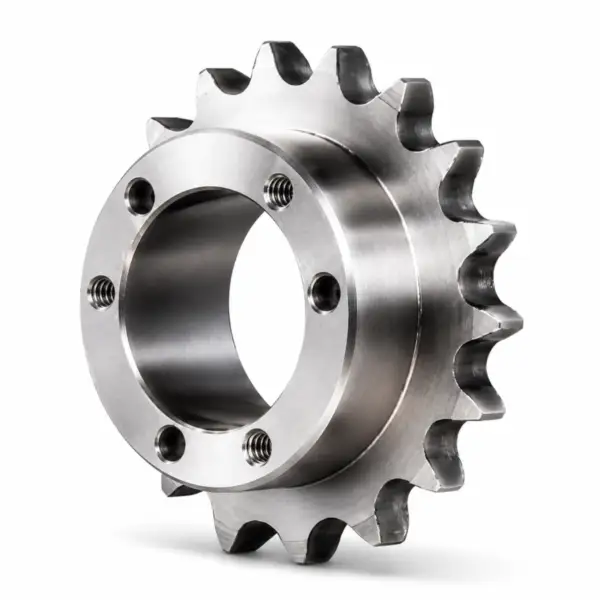
A stock-bore sprocket leaves the final shaft interface for machining. It is useful when a shop controls the bore and keyway locally, but the sprocket is not ready to mount until those operations are completed and checked for concentricity. For stock bore, finished bore, qd, and taper-lock sprockets, use stock bore sprocket as the primary field reference and compare it with QD bushing sprocket; resolve any disagreement before releasing the sprocket specification. For component context, review QD and Taper-Lock sprockets जब संबंधित उत्पाद परिवार उसी चेन-ड्राइव इंटरफेस से संबंधित हो।
Verification for stock bore, finished bore, qd, and taper-lock sprockets: compare the field condition with nominal data and treat any difference that changes roller seating, shaft support, or service access as a release criterion.
2. Finished bore
A finished-bore sprocket arrives machined to a specified shaft size, typically with a keyway and retention features. It reduces local machining work but ties the part more closely to one shaft diameter. The practical check for finished bore is to connect the observed condition to finished bore sprocket, then confirm that Taper-Lock sprocket does not introduce a second compatibility limit.
Use the wear evidence to test finished bore: asymmetric polishing, fretting, root impact, or chain climbing should lead to a measurable correction rather than a like-for-like replacement.
3. QD bushing
A QD system uses a split tapered bushing drawn into a mating tapered hub. It is valuable when shaft-size flexibility and removal are important, but the bushing and sprocket must be the matching QD series and installed with the published screw sequence. Record the evidence for qd bushing beside the measured QD bushing sprocket. If keyway is size- or supplier-dependent, carry the drawing reference into the purchase record. For component context, review रोलर चेन ड्राइव घटक जब संबंधित उत्पाद परिवार उसी चेन-ड्राइव इंटरफेस से संबंधित हो।
For procurement, express qd bushing as verifiable data: chain standard, measured dimension, drawing reference, material condition, or operating requirement. Do not specify only ‘same as old.’
4. Taper-Lock bushing
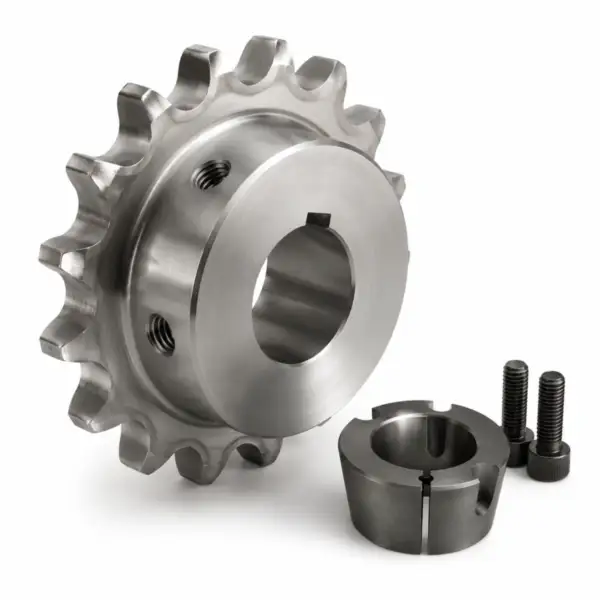
Taper-Lock also uses a split taper, but its geometry, screw arrangement, and bushing series are not interchangeable with QD. Treat it as a distinct mounting system and follow the selected manufacturer’s installation and removal instructions. Treat taper-lock bushing as a pass/fail interface: document Taper-Lock sprocket, inspect the mating component, and use concentric mounting to confirm the final operating fit.
For commissioning, define how taper-lock bushing will be checked after installation: chain seating, runout, shaft clearance, tooth-side contact, rpm, or loaded inspection as applicable.
5. Lifecycle and inventory
A fixed finished bore can be simplest for a stable machine fleet, while interchangeable bushings can reduce the number of complete sprockets carried for several shaft sizes. The economic choice depends on local machining, downtime, and spare-parts policy. A useful field note for stock bore, finished bore, qd, and taper-lock sprockets pairs keyway with stock bore sprocket. That keeps the decision tied to the actual chain drive rather than a visual match.
Verification for stock bore, finished bore, qd, and taper-lock sprockets: compare the field condition with nominal data and treat any difference that changes roller seating, shaft support, or service access as a release criterion.
चयन प्रक्रिया
- 1. Confirm the shaft. Measure shaft diameter, keyway, shoulder position, usable length, surface condition, and any evidence of fretting or previous bushing damage. Photograph the setup when useful and identify the reference surfaces used to establish Taper-Lock sprocket.
- 2. Confirm the sprocket hub. Check the exact hub series, maximum bore, bushing number if applicable, and length through bore on the supplier drawing. If the observation changes keyway, stop and update the replacement specification before continuing.
- 3. Assess field access. Verify that installation screws, removal holes, keys, and puller or wrench access remain reachable after guards and bearings are in place. Repeat or rotate the check when wear could bias concentric mounting; the goal is nominal geometry, not one convenient reading.
- 4. Decide machining responsibility. If using stock bore, define who will finish-bore, key, deburr, and inspect runout before the sprocket reaches the machine. Photograph the setup when useful and identify the reference surfaces used to establish stock bore sprocket.
- 5. Plan installation verification. Include a radial-runout and axial-face check after mounting, because a nominally correct bore system can still seat poorly on a damaged shaft. If the observation changes finished bore sprocket, stop and update the replacement specification before continuing.
- 6. Plan the next replacement. Decide whether the spare should be a complete finished-bore assembly or a common sprocket plus multiple bushings, and label the stored parts by shaft location. Repeat or rotate the check when wear could bias QD bushing sprocket; the goal is nominal geometry, not one convenient reading.
For stock bore, finished bore, qd, and taper-lock sprockets, cross-check adjacent drive interfaces with industrial power transmission products स्थापना या प्रतिस्थापन रिकॉर्ड जारी करने से पहले।
अंतिम चयन जाँच
01 से बचें
Buying a stock-bore sprocket as if it were ready to install. Document the corrective requirement specifically for stock bore, finished bore, qd, and taper-lock sprockets before the part is released.
02 से बचें
Mixing QD and Taper-Lock bushings because their outside appearance is similar. Document the corrective requirement specifically for stock bore, finished bore, qd, and taper-lock sprockets before the part is released.
03 से बचें
Reusing a damaged key or fretted shaft under a new bushing. Document the corrective requirement specifically for stock bore, finished bore, qd, and taper-lock sprockets before the part is released.
04 से बचें
Applying remembered torque values instead of the bushing manufacturer's current data. Document the corrective requirement specifically for stock bore, finished bore, qd, and taper-lock sprockets before the part is released.
कॉन्फ़िगरेशन क्रॉस-चेक: इस का उपयोग करें sprocket mounting options only to compare common construction terminology for stock bore, finished bore, qd, and taper-lock sprockets; release the part from the actual chain, shaft, and controlled drawing.
FAQ: Stock bore, finished bore, QD, and Taper-Lock sprockets — practical engineering questions
Stock bore vs finished bore sprocket: what is the practical difference?
Stock bore leaves the final bore and keyway machining to the user or machine shop. Finished bore is supplied at the target shaft size with the required shaft-interface features. The choice is mainly about machining control, lead time, and whether one shaft size is fixed.
QD vs Taper-Lock sprocket: are the bushings interchangeable?
No. They are different tapered bushing systems with different hub geometry and screw arrangements. Use the bushing series specified for the sprocket and follow that manufacturer's installation and removal procedure.
Which sprocket mounting system is easiest to remove during maintenance?
Interchangeable taper-bushing systems are often attractive where field removal matters, but access to screws and removal holes must be available. A finished-bore sprocket can also be easy to remove if the shaft fit, key, and axial retention are service-friendly.
Do I still need to check runout on a QD or Taper-Lock sprocket?
Yes. A taper bushing improves repeatable mounting only when the shaft, bore, taper, and seating are clean and undamaged. Indicate radial and axial runout after assembly and compare with the equipment or sprocket specification.
When is a stock-bore sprocket the better choice?
Choose stock bore when local machining capability is strong, the shaft size is unusual, or the same sprocket blank must be adapted to several shaft interfaces. The machining drawing should control bore, keyway, concentricity, and hub wall thickness.
What information do I need to order a finished-bore or bushed sprocket?
State chain size, tooth count, strand count, shaft diameter, keyway, hub or bushing system, bushing series, material, axial location, and any maximum outside diameter or length-through-bore limit.