Industrial chains can look deceptively interchangeable. Two chains may have a similar pitch, comparable plate proportions, and even fit around the same shaft centers, yet differ in roller diameter, inner width, attachment geometry, plate construction, material, allowable operating conditions, or the sprocket tooth form they require. That is why a practical chain-selection process should begin with the duty of the machine and finish with a dimensional compatibility check, rather than beginning with a catalogue picture.
This guide gives maintenance teams, machine builders, and buyers a repeatable way to select among drive chains, conveyor chains, agricultural chains, engineering chains, leaf or hoisting chains, and stainless-steel variants. It also shows what information should be measured in the field before a replacement order is released. Exact load ratings, speed limits, lubrication intervals, and material limits remain manufacturer- and series-specific, so the final step is always to compare your collected data with the selected chain drawing, technical catalogue, and equipment manual.
- Function
- Power transmission, conveying, positioning, or lifting.
- Mechanical duty
- Load, speed, shock, starts, reversals, and duty cycle.
- Interfaces
- Pitch, roller or bush diameter, inner width, sprocket tooth form, bore, attachments, anchors, and guides.
- Environment
- Corrosion, washdown, dust, abrasion, temperature, and lubricant restrictions.
1. First Decide What the Chain Must Actually Do
The most important first question is functional: is the chain transmitting rotary power, carrying material, moving a machine element, or supporting a lifting load? Those jobs create different dominant stresses and therefore favor different chain constructions.
A drive chain transfers torque between sprockets. The key inputs are power or chain pull, shaft speed, sprocket tooth count, ratio, duty cycle, shock loading, shaft alignment, and lubrication method. Start with the available industrial roller chain only after those operating inputs are known.
A conveyor chain is selected around chain pull, product or bulk-material load, conveyor direction, slider or roller support, attachments, start-stop behavior, contamination, and the path through head, tail, and take-up sections.
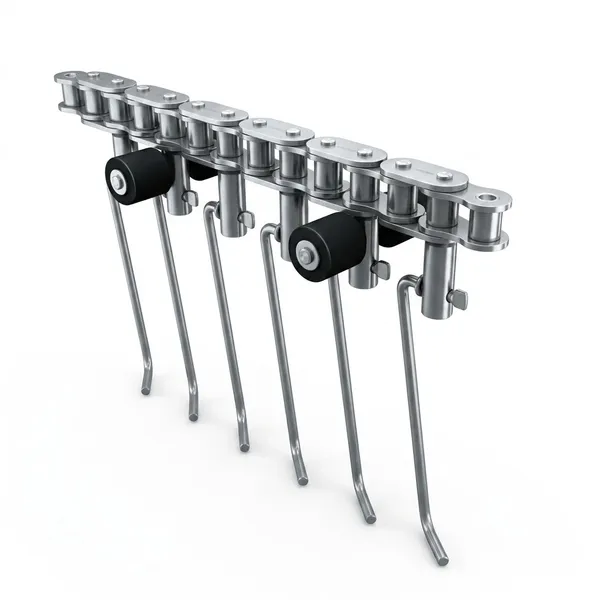
Leaf and hoisting chains operate in safety-critical tensile service. Replacement decisions must preserve the specified chain series, lacing, anchor interfaces, sheave geometry, proof or certification requirements, and machine-manufacturer instructions.
Agricultural and engineering chains often combine several of these functions. A harvesting machine may need timed power transmission plus crop conveying, while a heavy drag conveyor may use an engineering-class chain whose rollers, barrels, pins, and attachments are selected primarily for wear and impact resistance. Classifying the duty correctly prevents a common mistake: choosing a chain by pitch alone when the real requirement is controlled by attachment load, bearing area, side wear, shock, or corrosion.
2. Define Load, Shock, and Duty Cycle Before Choosing Size
Chain size should follow the force history of the application, not simply the motor nameplate. Begin by recording the normal transmitted or conveyed load, the maximum expected operating load, how often the machine starts and stops, whether material can jam, and whether the chain sees abrupt reversals. A smoothly loaded fan drive and a feeder that repeatedly starts with material already on the conveyor may use the same motor power but create very different chain stresses.
For a power-transmission drive, collect motor or gearbox output power, driving shaft speed, driven shaft speed, driver and driven sprocket tooth counts, center distance, and the nature of the load. For a conveyor, record the moving mass, conveyed material mass, support method, incline or lift height, conveyor length, acceleration pattern, and any accumulation zones. For lifting equipment, use the equipment manufacturer’s load and safety requirements rather than adapting a power-transmission selection rule.
Do not turn a preliminary engineering estimate into a claimed chain rating. Once the duty has been described, check the selected manufacturer’s power-rating or allowable-load tables for the exact chain series. If a catalogue requires service, speed, temperature, or lubrication factors, apply those factors exactly as defined by that catalogue. If one input is unknown, stop and measure or obtain it from the machine documentation instead of inserting an assumed value.
3. Match Chain Speed, Pitch, and Sprocket Tooth Count as a System
Chain pitch affects more than physical size. A larger pitch generally produces larger articulation steps as the chain enters and leaves a sprocket. Sprocket tooth count, chain speed, and pitch therefore influence smoothness, engagement impact, noise, and wear together. High-speed drives often benefit from smaller pitch chains with more teeth in engagement, while slow heavy conveying duties may use larger pitch or purpose-built conveyor chains.
For an existing machine, the safest replacement path is to identify the installed chain and sprockets dimensionally before considering any change in pitch. Measure chain pitch from pin center to pin center over several pitches, measure the inside width between inner plates, identify roller or bush diameter, count the sprocket teeth, and record the sprocket bore and hub arrangement. If wear makes one measurement uncertain, use several independent dimensions instead of forcing a match from a single worn feature.
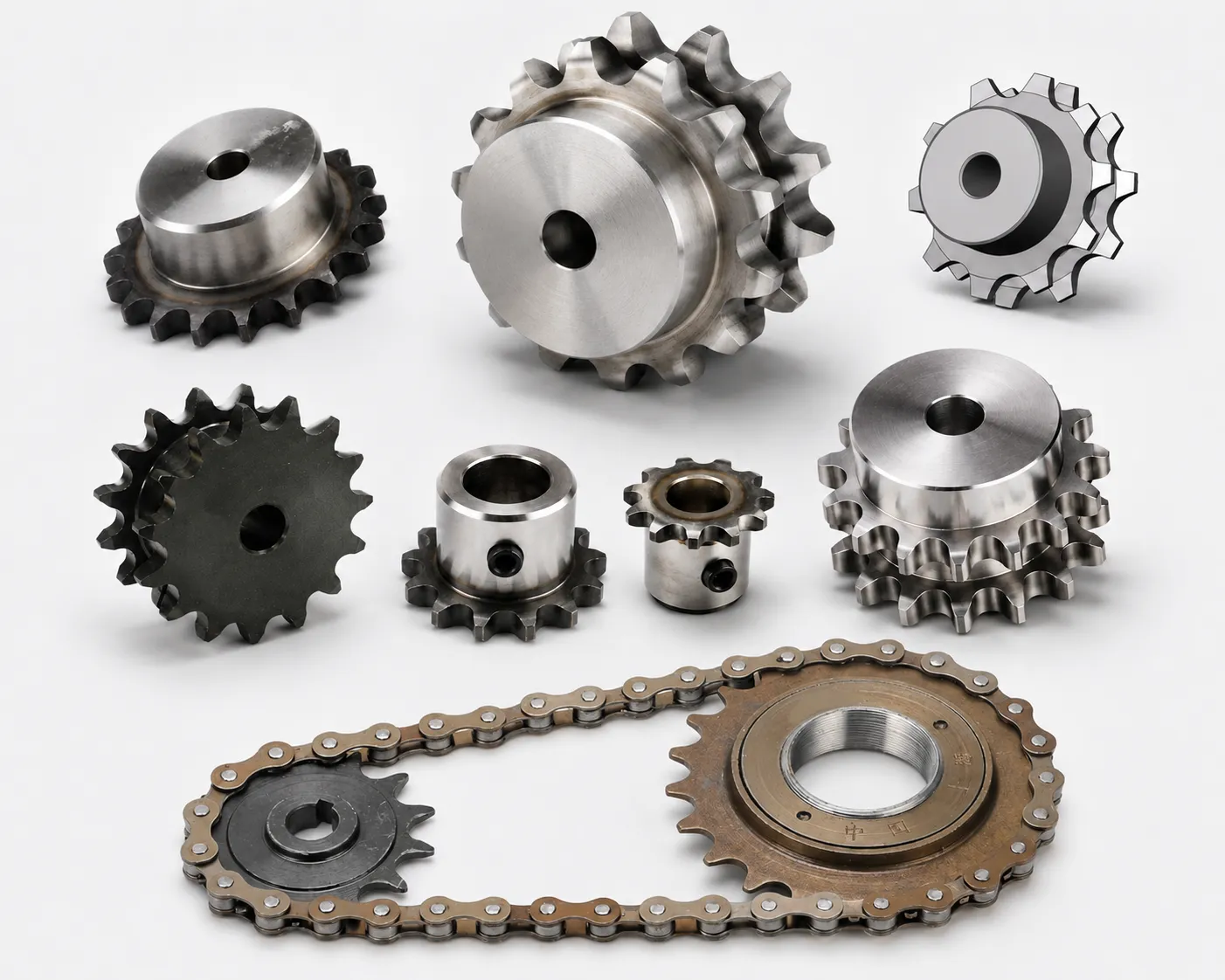
If the chain series changes, the sprocket usually needs to be checked or replaced as part of the same engineering decision. A sprocket that is close in outside diameter is not necessarily compatible with a different chain pitch or roller diameter. Review the rullaketjun ketjupyörät using tooth count, chain series, bore, keyway, hub style, and available shaft space. For broader early-stage comparison, a practical roller chain and sprocket selection guide reference can help organize pitch, chain family, and sprocket questions, while the machine drawing remains the controlling reference for the actual installation.
4. Choose the Material From the Real Environment, Not From a Generic Label
Material selection begins with exposure. Record whether the chain runs indoors or outdoors, whether it is washed down, whether water remains on the chain after cleaning, whether salts or process chemicals are present, whether abrasive dust reaches the joints, and whether lubrication is restricted by the process. Temperature also matters because both chain material behavior and lubricant performance are application-dependent.
Carbon-steel chain is common where strength, wear resistance, cost, and conventional lubrication are the main priorities. Stainless-steel chain can be attractive where corrosion resistance or washdown compatibility dominates, but it should not be treated as an automatic one-for-one upgrade. Material grade, pin-bushing tribology, allowable load, speed, lubricant compatibility, and the mating sprocket material must all be checked for the exact chain series.
For wet, corrosive, or sanitation-sensitive applications, compare the documented environment with the available stainless steel roller chain. Before changing material, confirm the required chain pull, the chain’s published allowable load in the relevant environment, the sprocket material, cleaning chemistry, and any process-specific hygiene rules. A corrosion-resistant chain that is undersized for the mechanical duty is not a successful upgrade.
5. Use a Selection Matrix to Narrow the Chain Family
| Primary duty | Likely chain family | Inputs to verify | Common selection error |
|---|---|---|---|
| Rotary power transfer | Roller or drive chain | Power, RPM, ratio, shock, centers, lubrication | Choosing pitch from appearance only |
| Product or bulk conveying | Conveyor or engineering chain | Chain pull, attachments, support, speed, environment | Ignoring attachment and roller loads |
| Agricultural feeding or harvesting | Agricultural application chain | OEM geometry, attachments, contamination, shock | Replacing with generic roller chain |
| Vertical lifting | Leaf or hoisting chain | Series, lacing, anchors, sheaves, OEM safety data | Using drive-chain criteria for lifting |
| Wet or corrosive duty | Stainless or coated chain as specified | Chemical exposure, load, speed, lubricant, sprocket material | Assuming stainless has identical ratings |
| Use the matrix to narrow the family, then confirm the exact series with manufacturer data and machine requirements. | |||
This matrix is a screening tool, not a final selection chart. The final chain size and construction must be checked against the exact manufacturer’s tables and the machine’s duty. It is especially important to separate safety-critical lifting from ordinary conveying or power transmission because the inspection, replacement, and documentation rules may be different.
Send the application, load, speed, chain dimensions, sprocket details, and operating environment for a focused selection review.
6. Treat Lubrication and Maintenance Access as Selection Inputs
Lubrication is not merely a maintenance task added after installation. It influences whether a chain family is appropriate for the machine. In a conventional roller chain, relative motion occurs at the pin and bushing joint. Lubricant must reach that joint rather than simply making the outside of the rollers look wet. If the machine layout prevents safe and repeatable access to the lubrication points, the selection should account for that constraint from the beginning.
Record whether lubrication will be manual, drip-fed, brushed, or automatic; whether the chain is accessible while stopped; whether overspray can contaminate a product; and whether dirt will combine with heavy lubricant to form an abrasive paste. For a conveyor, also inspect guides and wear strips because friction outside the chain joint can dominate the required chain pull. For an exposed agricultural drive, contamination and wash-off may control service behavior even when the basic transmitted load is modest.
Maintenance access can also justify choosing a chain and sprocket arrangement that is easier to inspect, tension, and replace. If a chain is hidden behind guards that take substantial time to remove, condition checks may be delayed. If a take-up has very little remaining travel, a replacement chain may need a center-distance or tensioner review rather than simply installing the same number of links and moving on.
7. For Replacement Work, Build the Specification From Measurements
When the original part number is unreadable or documentation is incomplete, create a replacement record before contacting suppliers. Clean enough of the chain to expose pins, rollers, and plates. Photograph the chain next to a scale. Measure several pitches rather than one worn joint. Record the inside width between inner plates, roller or bush diameter, plate height and thickness where accessible, strand count, connecting-link style, and any attachments. On the sprockets, count teeth and record bore, keyway, hub style, and shaft diameter.
Then document the operating side of the problem: machine type, drive or conveyor function, motor or gearbox details, shaft speeds if known, material being conveyed, loading pattern, environment, lubrication method, operating hours or cycles available from the machine records, and the failure symptom that triggered replacement. If the chain is being changed because of rapid wear, noise, stiff joints, side rubbing, or repeated tension adjustment, preserve that information. It may indicate an alignment, lubrication, sprocket, guide, or loading problem that a new chain alone will not correct.
Finally, ask the supplier to confirm the chain series against the measurements and provide the drawing or dimensional table used for the match. For a safety-critical or OEM-controlled application, obtain the required documentation before installation. Do not substitute a dimensionally similar chain if the machine manual specifies a particular construction, lacing pattern, material, proof requirement, or approved replacement.
8. Verify the Complete System Before Releasing the Order
A good purchase specification should answer five questions. First, what chain family and standard or series is required? Second, what exact dimensions and strand or attachment configuration must match? Third, what load, speed, shock, and environmental conditions will the chain experience? Fourth, what sprocket, guide, anchor, or take-up interfaces must remain compatible? Fifth, what inspection and lubrication method will be practical after installation?
If any of those answers is missing, the chain selection is not finished. A low purchase price cannot compensate for a wrong pitch, mismatched roller diameter, incompatible attachment, insufficient environmental resistance, or a chain that cannot be lubricated where it is installed. Conversely, oversizing without checking sprocket diameter, shaft load, guard clearance, and chain speed can create a new set of problems.
- Machine function and load case recorded.
- Chain pitch, inner width, roller or bush diameter, and strand count verified.
- Sprocket tooth count, bore, hub, and keyway confirmed.
- Environment, washdown, corrosion, dust, and temperature exposure documented.
- Lubrication method and maintenance access reviewed.
- Attachments, anchors, guides, or take-up interfaces checked.
- Manufacturer drawing and rating data reviewed for the exact series.
- Safety-critical or OEM-specific requirements confirmed before substitution.
Usein kysytyt kysymykset
What size roller chain do I need for an industrial drive?
Size the chain from the actual duty, not pitch alone. Record power or chain pull, shaft speeds, shock, duty cycle, center distance, space limits, and lubrication. Apply the service factor and rating method for the exact chain series, then verify sprocket tooth count and diameter. Use the manufacturer rating table for the real operating condition rather than tensile strength by itself.
How do I measure roller chain size for replacement?
Measure pitch, roller diameter, inside width, and strand count, then compare them with the manufacturer chart. Clean and straighten the chain, measure across several consecutive pitches, and divide by the number of pitches. Record attachment geometry when relevant. Because pin-bushing wear increases measured length, cross-check an old chain against the sprocket and readable chain markings before ordering.
How do I match a roller chain to a sprocket correctly?
Verify chain standard, pitch, roller diameter, inside width, strand count, sprocket tooth form, and nominal tooth width. Also confirm tooth count, bore, keyway, hub style, shaft fit, and clearance. Outside diameter alone does not prove compatibility. If the chain family changes, compare both component drawings and confirm the combination.
ANSI vs British Standard roller chain: are they interchangeable?
Do not assume interchangeability because the pitch looks similar. ANSI and British Standard/ISO chains use different designations and can differ in width, roller dimensions, plate geometry, and sprocket details. A documented manufacturer exception is not a universal rule. Compare the chain drawing, pitch, roller diameter, inside width, strand count, and sprocket specification before substitution.
Stainless steel roller chain vs carbon steel: which is better for washdown and corrosion?
Stainless steel is generally favored when corrosion resistance, frequent washdown, cleaning chemistry, or sanitation requirements dominate. Carbon steel can provide better wear and fatigue performance when corrosion is manageable. Check load, speed, temperature, lubrication restrictions, and chemical exposure against the published ratings of the exact chain series, and review sprocket material and cleaning compatibility too.
Should I replace roller chain sprockets when installing a new chain?
Inspect sprockets before installing the new chain. Hooked, asymmetric, damaged, badly worn, or misaligned teeth can prevent correct seating and accelerate wear. Replace sprockets when tooth condition is unacceptable, and correct alignment, bearing, lubrication, or take-up problems before commissioning. Lightly used sprockets do not automatically require replacement, but they still need inspection.
Application review
Ready to Specify the Right Chain?
Share your chain dimensions, load, speed, sprocket information, operating environment, and photos. We can use those details to narrow the chain family and identify the compatibility checks that matter before you release the order.
Cxm.