Selection Snapshot
The Sprocket Is Not a Stand-Alone Part
A sprocket is part of a chain-and-shaft system. Selecting it by outside diameter or by tooth count alone can create a drive that physically installs but meshes poorly, wears rapidly, runs noisily, or changes the required speed ratio. Start by identifying the exact chain series and duty, then verify the mounting interface and operating environment before choosing the final construction.
For most industrial replacements, the minimum useful record is: chain standard and size, number of strands, sprocket tooth count, shaft diameter, bore and keyway arrangement, hub style, available outside-diameter envelope, material or corrosion requirement, and whether the existing chain and mating sprocket are still serviceable.
Four Inputs to Confirm First
- Chain interface
- Standard or series, pitch, roller diameter, inner width, and strand count.
- Drive geometry
- Driver and driven tooth counts, center distance, wrap, rotation direction, and space envelope.
- Shaft connection
- Shaft diameter, keyway, finished bore or bushing system, hub length, and axial retention.
- Duty and environment
- Power or chain pull, speed, shock, starts, reversals, contamination, corrosion, and maintenance access.
Common Ordering Mistake
“It is a 1/2-inch pitch sprocket” is not a complete specification.
Different chain standards can share a nominal pitch while using different roller dimensions, widths, or related tooth geometry. A replacement should be checked against the complete chain designation or measured chain dimensions, not pitch alone.
1. Match the Chain Standard, Pitch, Roller, Width, and Strand Count
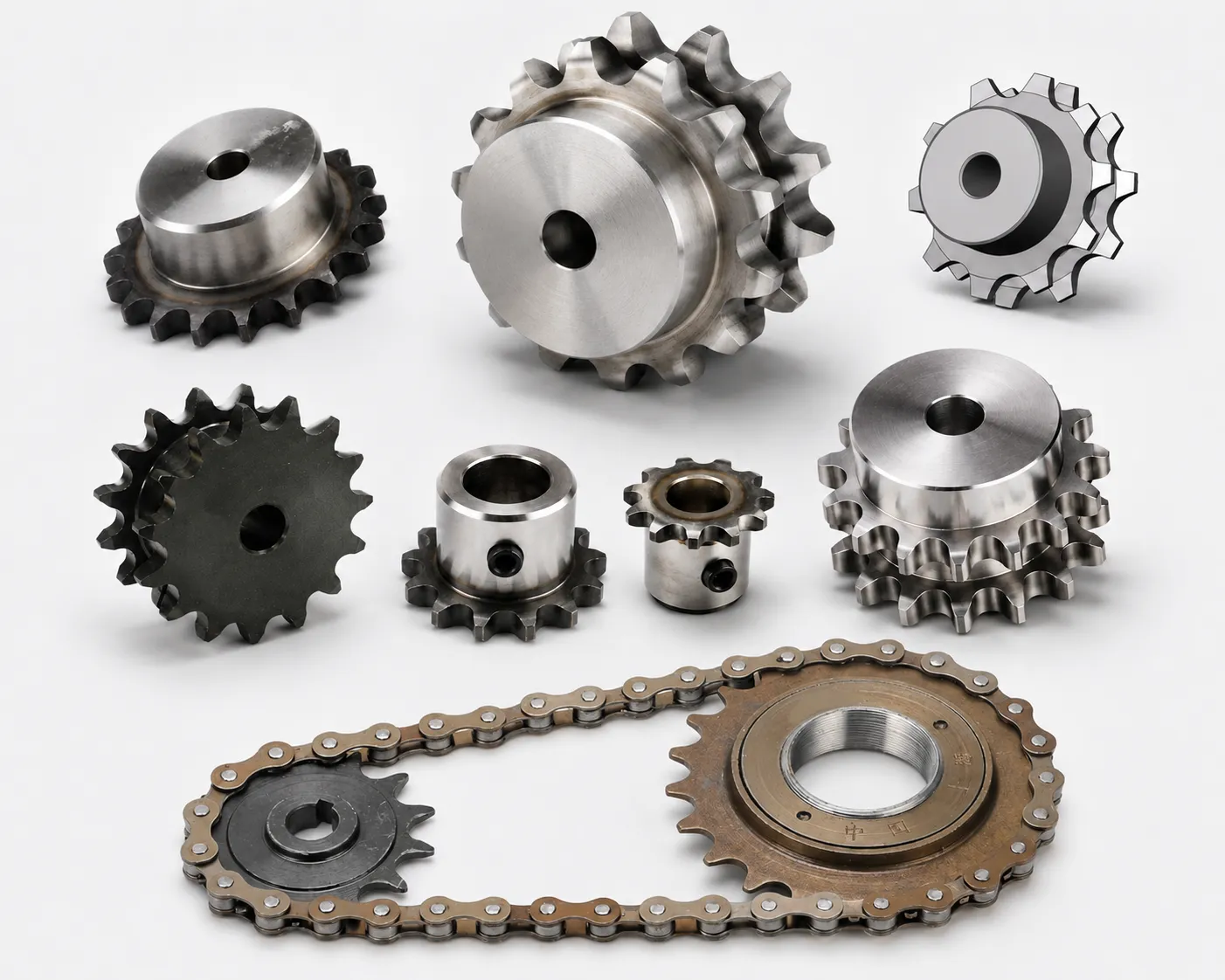
First identify the chain. For a precision roller-chain drive, record the standard or exact chain number and the number of strands. ISO 606 covers short-pitch precision roller and bush chains and their associated sprockets, while ASME B29.1 covers precision power-transmission roller chains, attachments, and sprockets. The practical implication is simple: the sprocket must be made for the chain family actually installed.
Pitch is the center-to-center distance between adjacent chain pins, but pitch alone is not enough to prove compatibility. Check roller diameter and the clear width between the inner plates as well. If you are replacing a complete drive, the industrial drive chains used with the sprocket should be confirmed from a drawing, chain marking, or field measurements before machining the bore.
For duplex or triplex drives, confirm strand count and tooth-row spacing. A single-strand sprocket cannot simply be substituted into a multi-strand drive, and a “double single” sprocket for two independent chains is not the same component as a duplex sprocket designed for one double-strand chain.
2. Select Tooth Count from Ratio, Smoothness, and Space
Tooth count does more than set sprocket diameter. It changes the speed ratio, the articulation angle of each chain joint as it enters and leaves the sprocket, and the magnitude of polygonal or chordal speed variation. More teeth generally produce smoother engagement, while very small sprockets increase articulation and dynamic effects.
Core Ratio Relationship
Output RPM = Input RPM × Driver Teeth ÷ Driven Teeth
If an 18-tooth driver turns at 900 rpm and drives a 54-tooth sprocket, the ideal driven speed is 300 rpm. The tooth ratio is 3:1. Actual drive selection must still be checked against the chain manufacturer’s power or allowable-load ratings.
As a general design starting point, Tsubaki recommends 15 or more teeth for the high-speed sprocket in normal selection, with 13 or more still preferred when ratio constraints are large; fewer teeth may be used in very slow, non-impact conditions only after checking the manufacturer’s rating method. That guidance is useful because the smallest sprocket usually experiences the highest engagement frequency.
Pitch diameter can be estimated from Dp = p ÷ sin(180°/Z), where Dp is pitch diameter, p is chain pitch, and Z is sprocket tooth count. This is useful for checking whether a proposed tooth count fits the machine envelope before a detailed drawing is released. Do not substitute outside diameter for pitch diameter in center-distance or ratio calculations.
If you are selecting a new drive rather than replacing an existing ratio, review the available roller chain sprockets only after the chain pitch, minimum acceptable tooth count, speed ratio, and shaft-space constraints have been established.
3. Specify the Bore and Hub as Carefully as the Teeth
Shaft data to record
- Shaft diameter and actual measured condition.
- Keyway width, depth, orientation, and key standard.
- Available hub diameter and length through bore.
- Axial location relative to bearings, guards, and adjacent components.
- Retention method: bushing, key and set screw, locking device, or other approved arrangement.
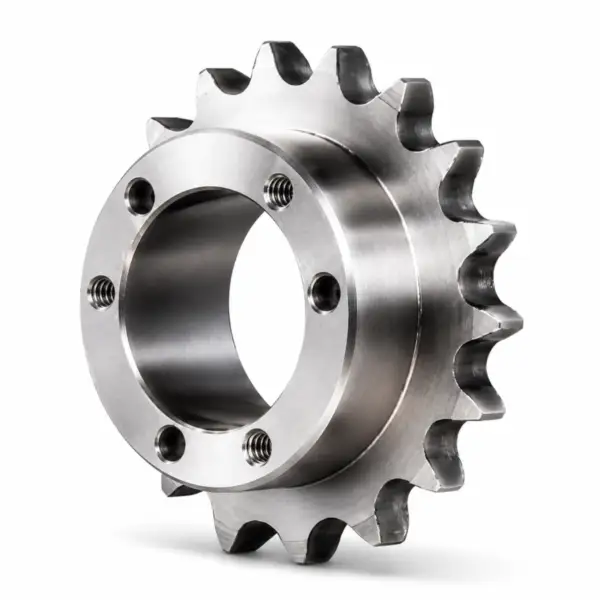
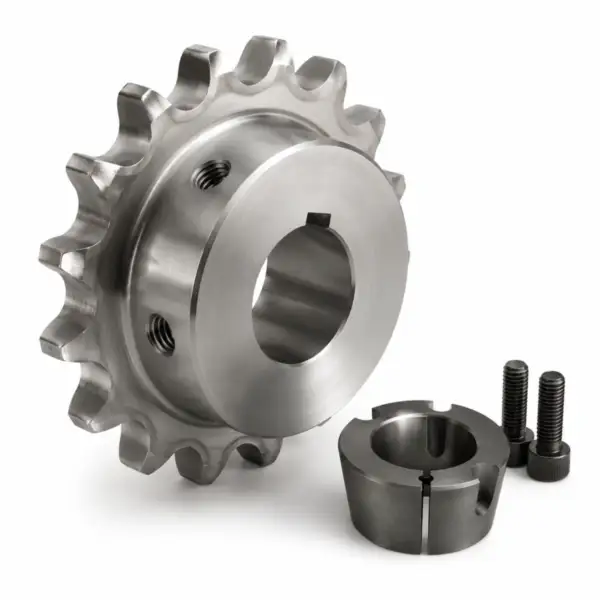
A finished-bore sprocket is appropriate when the shaft diameter and keyway are known and a direct keyed fit is desired. A stock- or pilot-bore sprocket is useful when final machining will be completed by a qualified machine shop. QD and taper-lock systems are often selected where standardized bushings simplify shaft adaptation and future removal. The correct choice depends on shaft size, available hub material, required concentricity, installation access, and maintenance practice.
Do not enlarge a stock sprocket bore simply because the shaft fits inside the hub diameter. Manufacturers publish maximum bore limits because the remaining hub wall, keyway depth, and local stress around the key must remain adequate. When in doubt, move to a larger hub style, a different tooth count, or a bushing-mounted design rather than removing excessive hub material.
4. Choose Material and Tooth Treatment from the Real Wear Environment
Material selection should start with the failure mode you are trying to prevent. Carbon or medium-carbon steel is common for general industrial sprockets. Stainless steel is considered where corrosion or washdown is dominant. Engineering plastics may be useful in certain low-noise, low-corrosion, or nonmetallic applications, but their allowable load, temperature, and wear behavior must be verified for the specific design.
| Decision | Mida kontrollida | Risk if ignored |
|---|---|---|
| Material | Corrosion chemistry, washdown, temperature, chain material, impact and wear. | Corrosion, galling, tooth wear, contamination, or insufficient capacity. |
| Tooth hardening | Tooth count, speed, load, ratio, abrasive exposure, replacement frequency. | Accelerated flank wear and shortened chain-sprocket life. |
| Hub system | Shaft size, maximum bore, installation access, service frequency and runout. | Loose mounting, poor concentricity, weak hub section, difficult replacement. |
| Tooth count | Ratio, engagement frequency, chordal action, available diameter and ratings. | Noise, vibration, high articulation, poor packaging fit, wrong output speed. |
| Final selection must be checked against the chosen chain and sprocket manufacturer’s dimensional and rating data. | ||
Tooth hardening deserves separate consideration. High engagement frequency, small tooth counts, high ratios, heavy load, and abrasive contamination all increase the value of a harder working surface. Tsubaki specifically identifies small sprockets, high speed, large speed ratios, heavy loading, and abrasive atmospheres as conditions where hardened tooth tips may be needed. Use that as a screening question, then confirm the selected sprocket series and treatment.
In wet or corrosive plants, sprocket material should also be considered with the chain. If corrosion is driving the project, compare the sprocket requirement with compatible roostevabast terasest ketid rather than replacing only one half of the chain-and-sprocket system.
5. Inspect Alignment and Existing Wear Before Installing a New Sprocket
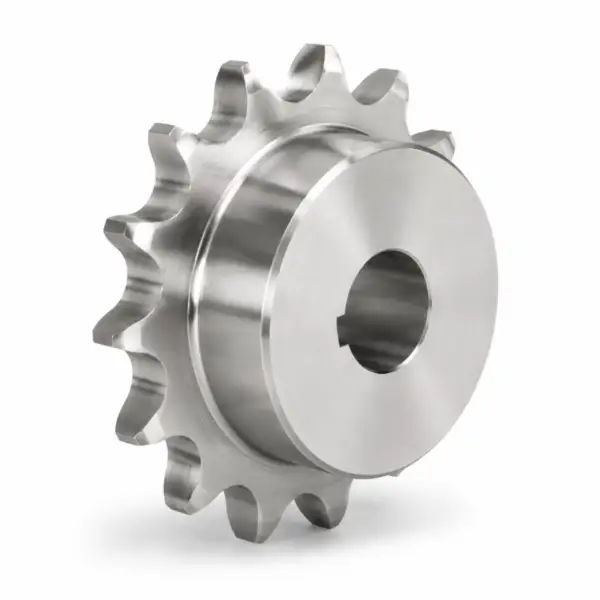
A technically correct new sprocket can still fail early if it is installed into a misaligned or heavily worn system. Side wear on the sprocket teeth is a strong clue that the sprockets or shafts are not correctly aligned. Check shaft parallelism, sprocket face alignment, radial runout, axial wobble, and whether the chain enters the tooth spaces without being forced sideways.
Also inspect the old chain. Wear elongation changes how the chain sits on the tooth profile. Both Tsubaki and Renold warn that running a new chain on a worn sprocket can accelerate chain wear because the tooth profile no longer matches the new chain geometry. The reverse is also important: a worn chain can rapidly reshape a new sprocket. Replacement decisions should therefore consider both components together.
Look for
- Hooked or asymmetric tooth flanks.
- Polished side faces from chain tracking error.
- Chain climbing high on the teeth.
- Uneven wear around the circumference.
- Bore, keyway, or bushing looseness.
Verify before restart
- Sprockets are coplanar across the shafts.
- Mounted runout is within supplier or machine limits.
- Chain slack/tension follows the machine requirement.
- Lubrication reaches the chain joints.
- Guards and take-up do not force misalignment.
6. Turn the Selection into a Procurement-Ready Sprocket Specification
Before releasing an order, put the data on one line drawing or specification sheet. This prevents a common failure mode in MRO purchasing: the right tooth count with the wrong bore, the right bore with the wrong chain series, or the right chain interface with a hub that collides with nearby bearings or guards.
- State the chain standard, chain number or dimensional identification, and strand count.
- State sprocket tooth count and whether it is the driver, driven, or idler position.
- Record bore diameter, keyway, hub type, hub diameter, length through bore, and axial location.
- Specify material, corrosion requirement, and whether tooth hardening is required or must be evaluated.
- Record shaft rpm, transmitted power or known chain pull, shock/reversing duty, and environmental contamination.
- Check maximum outside diameter, guard clearance, center distance, and service access.
- Confirm whether the new sprocket will run with a new chain, an inspected existing chain, or another new mating sprocket.
FAQ: Roller Chain Sprocket Selection Questions
What size roller chain sprocket do I need for my machine?
Start with the exact roller-chain size and standard, then choose tooth count from the required speed ratio and the chain manufacturer’s rating method. After that, verify bore, keyway or bushing, hub space, material, and environment. Outside diameter by itself is not enough to identify a replacement.
How do I match a sprocket to ANSI or ISO roller chain?
Use the chain designation or measure pitch, roller diameter, inner width, and strand count, then select a sprocket manufactured for that chain series. Do not assume two chains with the same nominal pitch use identical sprockets; verify the published dimensional standard or supplier drawing.
How many teeth should a roller chain drive sprocket have?
For normal industrial selection, a larger small-sprocket tooth count generally gives smoother engagement and lower articulation. Tsubaki uses 15 or more teeth as a general appropriate value and recommends 13 or more even when ratio constraints are large. Very small tooth counts should be reserved for low-speed conditions that have been checked against the manufacturer’s ratings and shock limits.
How do I calculate sprocket ratio and output RPM?
Divide driven sprocket teeth by driver sprocket teeth to get the reduction ratio. Output rpm equals input rpm multiplied by driver teeth and divided by driven teeth. For example, an 18-tooth driver turning at 900 rpm with a 54-tooth driven sprocket gives 300 rpm ideally. Check the chain rating and available center distance before finalizing the geometry.
QD vs taper-lock vs finished-bore sprocket: which mounting type is better?
There is no universal best type. Finished bore works well for a known keyed shaft and fixed installation. QD and taper-lock systems are useful when standardized bushings, removal, and shaft adaptation are valuable. Compare shaft diameter, maximum permissible bore, runout requirement, axial space, field access, and the supplier’s installation procedure.
Should I replace the sprocket when I replace a worn roller chain?
Inspect the sprocket before deciding. Hooked tooth flanks, poor seating of a new chain, side wear, severe root wear, or an abnormal wear pattern are strong reasons to replace or repair the sprocket. A new chain running on a worn sprocket can wear rapidly, so chain and sprocket condition should be evaluated as a matched system rather than as independent parts.