The old chain is evidence for conveyor chain selection bucket, but wear, previous substitutions, or maintenance changes can make it a poor master. A defensible service replacement starts from installation duty and uses the worn assembly only as one source of dimensional information.
Calculate the suspended weight of product, buckets, chain, and attachments on the loaded and return strands as applicable because gravity is a continuous load in vertical conveying. Then include starting, plugging, uneven filling, and material carryback in the duty review; the maximum transient pull can govern even when average throughput is modest. Those two checks define why bucket elevator chain and vertical chain pull belong in the same specification rather than being collected by separate teams after an order is placed.
For conveyor chain selection bucket, any numeric limit tied to take-up or head sprocket must come from the applicable chain-series or equipment documentation; the sections below focus on how to obtain and interpret the engineering inputs.
- Decisión primaria
- Select bucket-elevator chain using vertical chain pull, bucket spacing, attachments, dynamic loading, sprockets, take-up, and environmental conditions
- Primera evidencia
- bucket elevator chain
- Interfaz de acoplamiento
- bucket attachments
- Verificación de liberación
- head sprocket reconciled with the selected product and machine data.
Confirm bucket elevator chain, bucket attachments, and the mating geometry first; a failure here eliminates the candidate regardless of price.
Then compare vertical chain pull, take-up, and head sprocket with duty, environment, and service access before release.
1. Map the Machine Duty
Calculate the suspended weight of product, buckets, chain, and attachments on the loaded and return strands as applicable because gravity is a continuous load in vertical conveying
A bucket elevator imposes a continuous vertical gravity load that differs from a horizontal conveyor. Build the suspended-load inventory from the chain, buckets, fasteners, conveyed product, and any loaded return-side elements defined by the machine arrangement. Keep the loaded and return strands distinct, identify where the maximum tension occurs, and use the equipment or chain manufacturer’s elevator selection method rather than applying a horizontal conveyor shortcut. For conveyor chain selection bucket, use the accesorios de cadena transportadora range only after bucket elevator chain passes the machine check.
2. Follow the Load Through the Operating Cycle
Include starting, plugging, uneven filling, and material carryback in the duty review; the maximum transient pull can govern even when average throughput is modest
Average throughput does not describe the worst elevator event. Starting a fully loaded boot, uneven bucket filling, product packed around the boot, plugging at the discharge, carryback, and abrupt stops can raise pull or create impact. Review the operating history and controls for these cases. The selected chain must be evaluated with the appropriate service factors or transient method for that exact chain family; do not invent a universal multiplier.
3. Choose the Chain Architecture and Interfaces
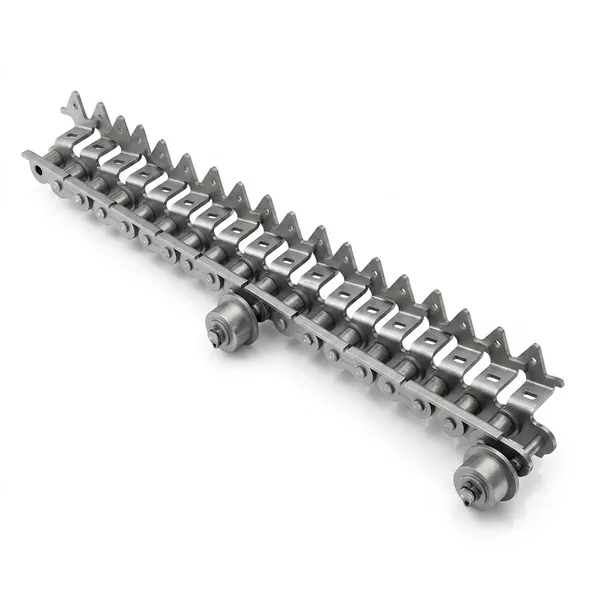
Match bucket attachment style, bolt pattern, attachment interval, chain strand spacing, and bucket clearance so the mechanical connection does not introduce bending into attachments or sidebars
Bucket attachments transfer product weight into the chain and therefore deserve their own drawing check. Record attachment style, hole pattern, spacing along the chain, strand spacing, bucket back geometry, bolt access, and clearance to the casing. Mislocated holes or forced bucket alignment can bend attachment links or sidebars. Verify that the bucket sits square to the strands without using fasteners to pull an incompatible pattern into position. Procurement for conveyor chain selection bucket can use the heavy material handling chains category after take-up is reconciled.
If bucket attachments agrees with released reference but head sprocket does not, treat conveyor chain selection bucket as an interface problem and survey the mating hardware in advance of changing chain size. If both agree yet the symptom remains, move upstream to load, alignment, lubrication, or support conditions. Numeric limits that belong to one series stay with that series.
4. Design for the Real Environment
Check head and boot sprockets, shaft alignment, take-up range, boot cleanout, and casing clearance because a vertical chain cannot tolerate uncontrolled lateral tracking
The head and boot assemblies control elevator tracking. Inspect head and boot sprocket alignment, shaft condition, tooth wear, take-up travel, boot cleanout, and side clearance through the casing. Product buildup at the boot or a restricted take-up can create lateral loading that a heavier chain will not cure. Tracking should remain stable through the full take-up range expected in normal service. For a broader component comparison, use the industrial chain selection resource only after head sprocket is verified.
| Controlar | Importancia para la ingeniería | Enfoque de verificación |
|---|---|---|
| Bucket Elevator Chain | calculate the suspended weight of product, buckets, chain, and attachments on the loaded and return strands as applicable because gravity is a continuous load in vertical conveying | Verify bucket elevator chain from a named datum or approved source, then reconcile vertical chain pull for conveyor chain selection bucket ahead of release. |
| Vertical Chain Pull | include starting, plugging, uneven filling, and material carryback in the duty review; the maximum transient pull can govern even when average throughput is modest | Verify vertical chain pull from a named datum or approved source, then reconcile bucket attachments for conveyor chain selection bucket before release. |
| Bucket Attachments | match bucket attachment style, bolt pattern, attachment interval, chain strand spacing, and bucket clearance so the mechanical connection does not introduce bending into attachments or sidebars | Verify bucket attachments from a named datum or approved source, then reconcile take-up for conveyor chain selection bucket in advance of release. |
| Take-Up | check head and boot sprockets, shaft alignment, take-up range, boot cleanout, and casing clearance because a vertical chain cannot tolerate uncontrolled lateral tracking | Verify take-up from a named datum or approved source, then reconcile head sprocket for conveyor chain selection bucket before release. |
| Puerta de liberación | Approve conveyor chain selection bucket only after field evidence, mating geometry, and the selected chain data agree. | |
Send bucket elevator chain, bucket attachments, the mating-component condition, duty, and photographs of the measured references so the open interface can be reviewed before ordering.
5. Protect Serviceability and Alignment
Select materials and lubrication for dust, moisture, temperature, corrosive product, or food-contact requirements, and verify whether oiling is practical without contaminating the product
Material and lubrication choices must reflect the product and the cleaning environment. Dust can turn excessive lubricant into an abrasive paste, washdown can remove oil from articulating joints, and corrosive material can attack plates, pins, attachments, or bucket fasteners differently. Establish whether lubrication is allowed near the product, how joints will be replenished, and which chain material and lubricant are approved for the process before selecting on strength alone. The piñones de cadena de rodillos category is the product route once head sprocket and bucket elevator chain are known.
6. Verify the Application Before Release
Commission by checking unloaded tracking, then staged product flow, motor current, chain tension behavior, bucket clearance, and carryback before accepting the selected chain
Commission a bucket elevator in stages. First verify unloaded tracking, bucket clearance, take-up movement, and smooth sprocket engagement. Introduce product gradually while observing motor current or drive load, chain behavior at head and boot, discharge, carryback, and any rubbing in the casing. Reinspect attachment fasteners and tracking after the controlled run. Acceptance should confirm stable conveying behavior, not merely that the elevator can complete one loaded cycle.
Field Example: Turning Conveyor Chain Selection Bucket Into a Release Decision
A buyer and technician can make conveyor chain selection bucket auditable by walking the drive together before the request for quotation is issued. Calculate the suspended weight of product, buckets, chain, and attachments on the loaded and return strands as applicable because gravity is a continuous load in vertical conveying. Next, the team checks vertical chain pull and bucket attachments while the relevant mating hardware is exposed. The sequence matters: it establishes function and geometry before a catalogue size is allowed to influence the decision.
The service-side review then applies two different questions. First, verify head and boot sprockets, shaft alignment, take-up range, boot cleanout, and casing clearance because a vertical chain cannot tolerate uncontrolled lateral tracking. Second, select materials and lubrication for dust, moisture, temperature, corrosive product, or food-contact requirements, and verify whether oiling is practical without contaminating the product. The team records take-up with the environment and maintenance access instead of treating it as a later service issue. That makes the specification usable by both procurement and maintenance.
Release follows only subsequent to commission by checking unloaded tracking, then staged product flow, motor current, chain tension behavior, bucket clearance, and carryback before accepting the candidate chain. The conveyor chain selection bucket work order keeps bucket elevator chain, bucket attachments, head sprocket, interface photographs, and the controlled document used for any series-specific limit.
Conveyor Chain Selection Bucket Release Checklist
- Calculate the suspended weight of product, buckets, chain, and attachments on the loaded and return strands as applicable because gravity is a continuous load in vertical conveying. Document the evidence for bucket elevator chain with a named reference.
- Include starting, plugging, uneven filling, and material carryback in the duty review; the maximum transient pull can govern even when average throughput is modest. Keep the vertical chain pull observation with the conveyor chain selection bucket work order.
- Match bucket attachment style, bolt pattern, attachment interval, chain strand spacing, and bucket clearance so the mechanical connection does not introduce bending into attachments or sidebars. Use the applicable product criterion when bucket attachments needs a numeric limit.
- Cross-check head and boot sprockets, shaft alignment, take-up range, boot cleanout, and casing clearance because a vertical chain cannot tolerate uncontrolled lateral tracking. Reconcile take-up with the mating hardware before release.
- Select materials and lubrication for dust, moisture, temperature, corrosive product, or food-contact requirements, and verify whether oiling is practical without contaminating the product. Repeat the head sprocket verify where position or wear can change the result.
- Commission by checking unloaded tracking, then staged product flow, motor current, chain tension behavior, bucket clearance, and carryback before accepting the candidate chain. Archive bucket elevator chain with the chain identity and equipment duty.
Conveyor Chain Selection Bucket FAQ
How do I choose or verify bucket elevator chain for conveyor chain selection bucket?
For conveyor chain selection bucket, the first review is bucket elevator chain. Calculate the suspended weight of product, buckets, chain, and attachments on the loaded and return strands as applicable because gravity is a continuous load in vertical conveying. For lifting or other safety-critical duty, the equipment-specific inspection and release method governs.
What machine data is needed before checking vertical chain pull?
With conveyor chain selection bucket, judge vertical chain pull in its real service state. Include starting, plugging, uneven filling, and material carryback in the duty review; the maximum transient pull can govern even when average throughput is modest. Include the mating sprocket, sheave, guide, or attachment whenever take-up is part of the load path.
How do I know whether bucket attachments is compatible with the existing system?
For this conveyor chain selection bucket question, verify bucket attachments and head sprocket together. Match bucket attachment style, bolt pattern, attachment interval, chain strand spacing, and bucket clearance so the mechanical connection does not introduce bending into attachments or sidebars. If a numeric limit is needed for head sprocket, use the product-specific equipment or chain-series criterion.
Can I select a replacement by take-up alone?
On conveyor chain selection bucket, appearance alone cannot establish take-up. Cross-check head and boot sprockets, shaft alignment, take-up range, boot cleanout, and casing clearance because a vertical chain cannot tolerate uncontrolled lateral tracking. If the take-up evidence conflicts with bucket elevator chain, resolve the interface before purchasing the replacement item.
When does head sprocket become the limiting factor for conveyor chain selection bucket?
A defensible conveyor chain selection bucket answer begins with measured head sprocket. Select materials and lubrication for dust, moisture, temperature, corrosive product, or food-contact requirements, and verify whether oiling is practical without contaminating the product. Keep the head sprocket reading with the maintenance note so future inspections can trend change.
What should be documented before releasing a conveyor chain selection bucket replacement order?
Before releasing conveyor chain selection bucket, document bucket elevator chain and bucket attachments. Commission by checking unloaded tracking, then staged product flow, motor current, chain tension behavior, bucket clearance, and carryback before accepting the candidate chain. Subsequent to correction, recheck bucket attachments under the same permitted process service state used to establish the symptom.
Cxm.