Rozsah inženýrství
Measurement Snapshot: Identifying roller chain pitch from an existing sprocket
Identify pitch by combining tooth count with chain measurements, sprocket catalog geometry, and roller fit instead of guessing from outside diameter. This article concentrates on roller chain pitch, sprocket tooth count, pin center distance, roller diameter, caliper diameter, and chain identification as field-verifiable decision inputs.
For identifying roller chain pitch from an existing sprocket, keep chain engagement, shaft mounting, operating duty, and maintainability in the same decision record; use the current drawing whenever an exact limit is model-specific.
Referenční číslo pole
- Rozhraní řetěz/zub
- Confirm roller chain pitch, sprocket tooth count, and the mating chain dimensions before changing hardware.
- Rozhraní hřídel/náboj
- Record pin center distance and mounting details that control concentricity, axial position, or load transfer.
- Provozní povinnost
- Document speed, load, shock, starts/reversals, contamination, washdown, and maintenance access relevant to identifying roller chain pitch from an existing sprocket.
- Záznam o ověření
- For identifying roller chain pitch from an existing sprocket, keep measured values, nominal drawing values, wear observations, and the final replacement requirement distinct in the service record.
Princip rozhodování
Release identifying roller chain pitch from an existing sprocket from measured interfaces, not appearance.
For identifying roller chain pitch from an existing sprocket, check the chain interface, shaft connection, duty, and installed geometry as separate acceptance items, then reconcile them in the final specification.
Postup měření v terénu
- 1. Mark and count teeth. Count a complete revolution and record the exact tooth count before interpreting any diameter measurement. Use the current machine drawing when roller diameter is model-specific, and keep the measured value in the service record.
- 2. Measure several chain pitches. Choose intact joints, measure between equivalent pin centers over as many accessible pitches as practical, and divide the total distance by the number of pitches. Before moving on, confirm that caliper diameter agrees with the mating chain or shaft interface relevant to this step.
- 3. Measure the roller. Use a caliper or micrometer across a clean roller and record the inner width between plates where accessible. Record the result against chain identification so the next step starts from measured evidence.
- 4. Compare candidate series. Use chain and sprocket tables to compare pitch, roller diameter, width, and expected sprocket diameter for the tooth count. Use the current machine drawing when roller chain pitch is model-specific, and keep the measured value in the service record.
- 5. Inspect seating. Wrap or place a known new-chain sample on several teeth and confirm the rollers enter the roots without climbing, binding, or excessive side clearance. Before moving on, confirm that sprocket tooth count agrees with the mating chain or shaft interface relevant to this step.
- 6. Document the final identification. Record the standard or chain number, measured values, tooth count, and the drawing or catalog page used for the cross-check. Record the result against pin center distance so the next step starts from measured evidence.
For identifying roller chain pitch from an existing sprocket, cross-check adjacent drive interfaces with průmyslové komponenty pro přenos energie před vydáním záznamu o instalaci nebo výměně.
1. Measure the chain first if it is available
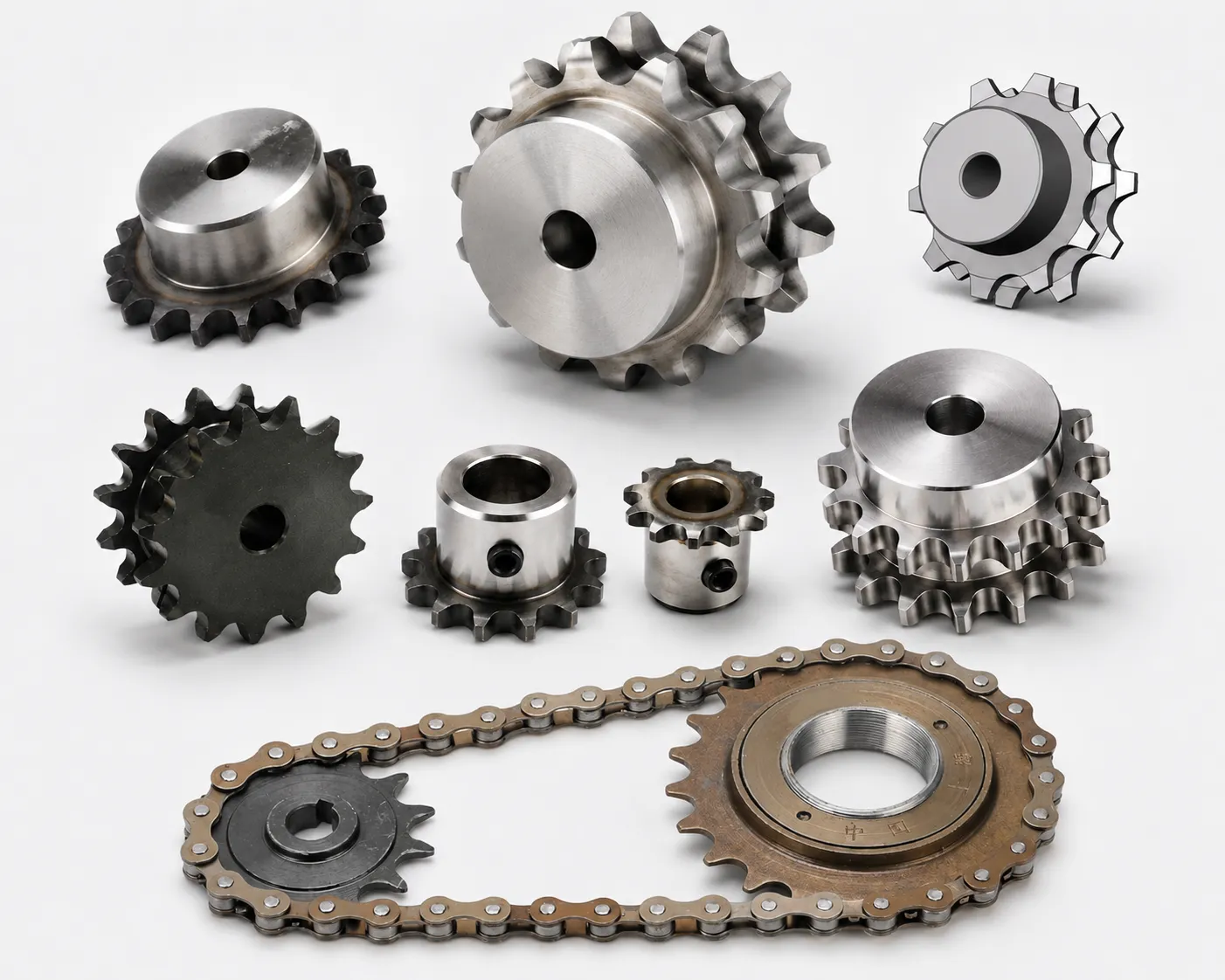
Pin-center spacing is the direct definition of chain pitch. Measure across multiple pitches and divide to reduce the effect of worn holes, dirt, and caliper placement. Record the evidence for measure the chain first if it is available beside the measured roller chain pitch. If pin center distance is size- or supplier-dependent, carry the drawing reference into the purchase record. For component context, review industrial roller chain sizes pokud je propojená produktová řada relevantní pro stejné rozhraní řetězového pohonu.
Use the wear evidence to test measure the chain first if it is available: asymmetric polishing, fretting, root impact, or chain climbing should lead to a measurable correction rather than a like-for-like replacement.
2. Use tooth count as the second identifier
A sprocket diameter has meaning only when the number of teeth is known. The same outside diameter can correspond to different pitch/tooth-count combinations. Treat use tooth count as the second identifier as a pass/fail interface: document sprocket tooth count, inspect the mating component, and use roller diameter to confirm the final operating fit.
For procurement, express use tooth count as the second identifier as verifiable data: chain standard, measured dimension, drawing reference, material condition, or operating requirement. Do not specify only ‘same as old.’
3. Use catalog diameters as a cross-check
Once a likely chain series and tooth count are known, compare pitch diameter, outside diameter, or caliper diameter with a manufacturer table. A consistent set of dimensions is stronger evidence than one matching number. A useful field note for identifying roller chain pitch from an existing sprocket pairs pin center distance with caliper diameter. That keeps the decision tied to the actual chain drive rather than a visual match. For component context, review roller chain sprockets pokud je propojená produktová řada relevantní pro stejné rozhraní řetězového pohonu.
For commissioning, define how use catalog diameters as a cross-check will be checked after installation: chain seating, runout, shaft clearance, tooth-side contact, rpm, or loaded inspection as applicable.
4. Check roller diameter and inner width
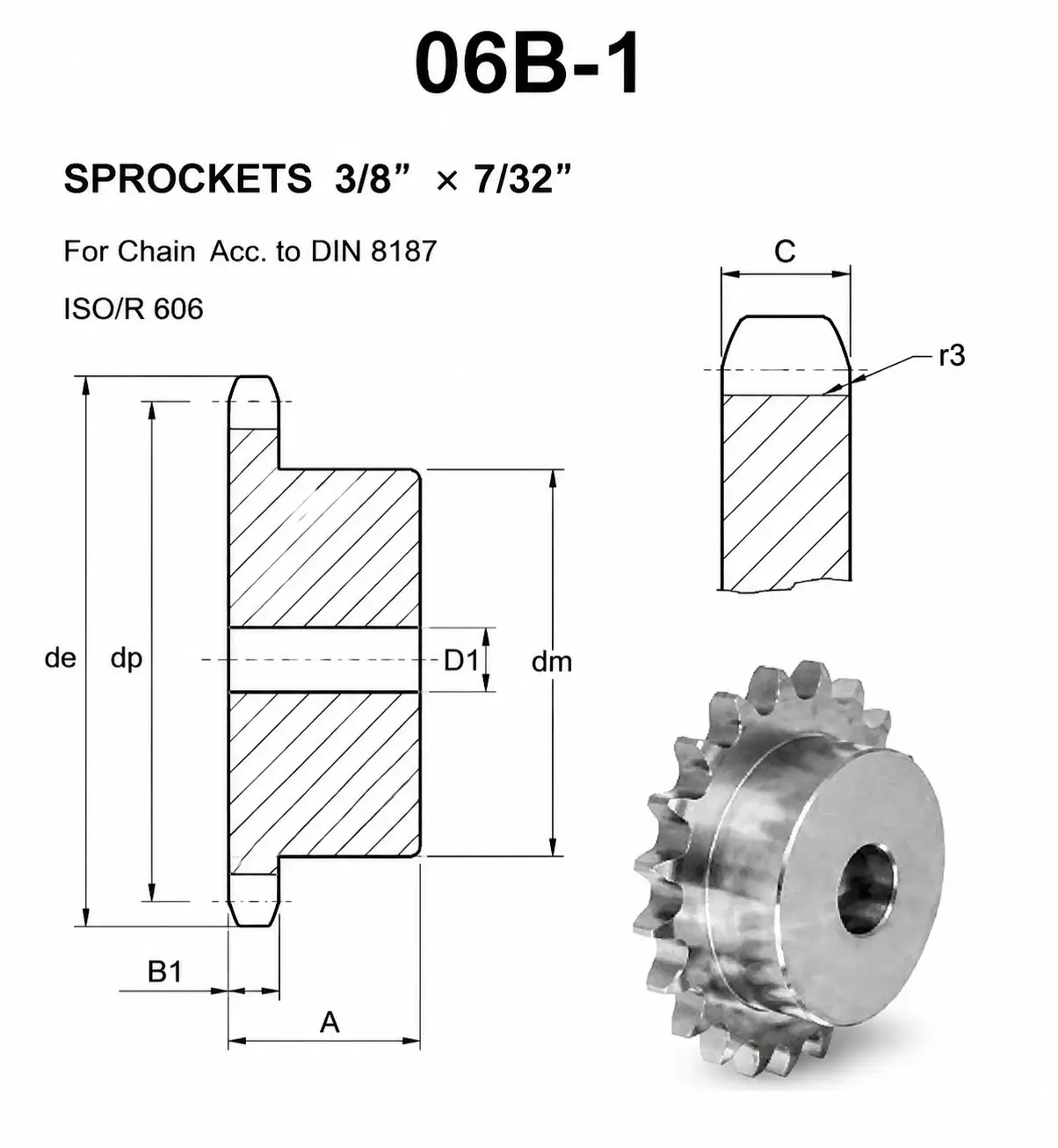
Chains with the same nominal pitch can differ in roller and width dimensions across series or standards. The mating tooth form must match the actual chain, not merely the pitch. For identifying roller chain pitch from an existing sprocket, use roller diameter as the primary field reference and compare it with chain identification; resolve any disagreement before releasing the sprocket specification.
Verification for identifying roller chain pitch from an existing sprocket: compare the field condition with nominal data and treat any difference that changes roller seating, shaft support, or service access as a release criterion.
5. Separate wear from identification
An elongated chain and hooked tooth profile can make seating look wrong even when the nominal series is correct. Identify the standard dimensions before diagnosing wear. The practical check for separate wear from identification is to connect the observed condition to caliper diameter, then confirm that roller chain pitch does not introduce a second compatibility limit.
Use the wear evidence to test separate wear from identification: asymmetric polishing, fretting, root impact, or chain climbing should lead to a measurable correction rather than a like-for-like replacement.
Záznam měření
| Faktor | Co ověřit | Logika uvolnění |
|---|---|---|
| Measure the chain first if it is available | Pin-center spacing is the direct definition of chain pitch | Record measure the chain first if it is available as a release check before installation or restart. |
| Use tooth count as the second identifier | A sprocket diameter has meaning only when the number of teeth is known | Correct the system cause linked to use tooth count as the second identifier before fitting new hardware. |
| Use catalog diameters as a cross-check | Once a likely chain series and tooth count are known, compare pitch diameter, outside diameter, or caliper diameter with a manufacturer table | Accept use catalog diameters as a cross-check when field evidence matches the controlled requirement. |
| Check roller diameter and inner width | Chains with the same nominal pitch can differ in roller and width dimensions across series or standards | Reconstruct nominal check roller diameter and inner width if wear has obscured the original geometry. |
| Separate wear from identification | An elongated chain and hooked tooth profile can make seating look wrong even when the nominal series is correct | Use the current supplier or machine limit for model-specific separate wear from identification. |
| Pro konečné schválení použijte naměřená data stroje a aktuální výkres řetězu/řetězového kola; limity specifické pro daný model nejsou zaměnitelné. | ||
Ověřovací kontroly
Vyhněte se 01
Dividing outside diameter by tooth count to estimate pitch. Document the corrective requirement specifically for identifying roller chain pitch from an existing sprocket before the part is released.
Vyhněte se 02
Assuming a 1/2-inch pitch chain must be ANSI #40. Document the corrective requirement specifically for identifying roller chain pitch from an existing sprocket before the part is released.
Vyhněte se 03
Using a stretched chain measurement across only one pitch. Document the corrective requirement specifically for identifying roller chain pitch from an existing sprocket before the part is released.
Vyhněte se 04
Ignoring roller diameter when two standards share nominal pitch. Document the corrective requirement specifically for identifying roller chain pitch from an existing sprocket before the part is released.
Křížová kontrola konfigurace: použijte toto roller chain pitch identification guide only to compare common construction terminology for identifying roller chain pitch from an existing sprocket; release the part from the actual chain, shaft, and controlled drawing.
FAQ: Identifying roller chain pitch from an existing sprocket — practical engineering questions
How do I find roller chain pitch from a sprocket?
Count the sprocket teeth and measure the chain pitch directly if the chain is present. Then compare the tooth count and sprocket diameters with a catalog for the candidate chain series.
Can sprocket outside diameter tell me the chain pitch?
Only as a cross-check when tooth count is already known. Outside diameter alone is ambiguous and wear at the tooth tips can change it.
How do I measure roller chain pitch accurately?
Measure center-to-center across several pins under light tension and divide by the number of pitches. Multiple-pitch measurement reduces the effect of individual joint wear and tool placement.
Why does a same-pitch chain not fit my sprocket?
The roller diameter, inner width, strand spacing, or standard series may differ, or the existing chain may be elongated. Compare the complete chain dimensions rather than pitch alone.
How can I tell ANSI chain from British Standard chain on a sprocket?
Look for chain markings and compare pitch, roller diameter, inner width, and sprocket tooth geometry with the relevant catalog. Some nominal pitches overlap, so multiple dimensions are needed.
What measurements should I record before ordering a sprocket for an unknown chain?
Record tooth count, multiple-pitch chain measurement, roller diameter, inner width, strand count, sprocket outside or caliper diameter, bore, hub, and photos of the tooth-root seating.